How to Not Welcome the Stranger

With a potentially bad election day looming for Donald Trump and Republicans next week, they and their propaganda machine have gone full tilt into promoting the story that a caravan of Honduran migrants is making its way north through Mexico, towards asylum in the United States. Predictably, the news is being used to mine fear among conservative voters and drive turnout in the midterms.

Among the groups most vocally speaking out against the migrants is, of course, white evangelicals, Trump’s most persistent base of support. At Vox, Tara Isabella Burton writes of the theological pretzels evangelical leaders are twisting themselves into to deny the very clear words of Scripture imploring Christians to welcome the stranger and the immigrant. Here is Burton:

This willingness to define seemingly straightforward passages in the Bible along politicized terms — reimagining what it means to be someone’s “neighbor” — speaks to a wider issue within white evangelicalism. The degree to which white evangelical identity is increasingly predicated on politicized whiteness — and on an insular and isolationist vision of community — reveals the extent to which white evangelicalism has become synonymous with Christian nationalism under the Trump administration. And, increasingly, white evangelicals are willing to selectively reinterpret the Bible to justify this.

“We’re seeing literal verses with long histories of interpretation, that favor the poor, that favor outcasts … redeployed in ways that fit now,” Bass said. “They’re inventing a new interpretation, whole hog, to fit the age of Trump.”

One of the most famous verses in the Bible is Galatians 3:28, which highlights how Christianity is supposed to transcend barriers of race, class, wealth, and nationality. “There is neither Jew nor Greek, there is neither bond nor free, there is neither male nor female: for ye are all one in Christ Jesus.”

It’s unclear how white evangelicals will reinterpret that verse now.

For many white evangelicals, the faith they subscribe to no longer credibly resembles Christianity in any traditional sense. Instead, it has become a form of white ethno-nationalism adhered to with religious fervor, fueled by fear and allegiance to Donald Trump.

Scripture is unequivocal: those who claim to be disciples of Christ are called to welcome the stranger and care for the needy, to love our fellow human beings as our neighbors. There is no grey area in this. The words of Christ in Luke 4 and Matthew 25 attest to this.

The migrants approaching our border are fleeing from their homes in Honduras, a nation with the world’s highest murder rate for at least six years running.  They are fleeing a nation that suffered the coup of a democratically elected government five years ago that we failed to counter in any way, and which is being racked by the violence of drug gangs, the result of deliberate US policy choices in Central and South America in the War on Drugs. In short, they are fleeing a problem created in large part by the United States. We owe these people. They are not a Soros-funded plot to destroy America. They are human beings who have heard their whole lives that America is the greatest country on the planet, and they took our marketing seriously. We have an obligation to address their arrival in a humane and logical way, rather than in a way driven by fear mongering and politics.

It is shameful that the loudest Christian voices are speaking words of the Anti-Christ about our suffering neighbors, but it certainly isn’t surprising. This is Trump’s America, and Trump’s church.

Why I Voted

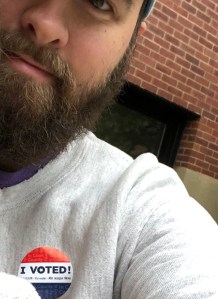
This morning, I went to the Evanston City Building, and voted. This is a pretty regular thing for me; I haven’t missed a primary or general election since I turned 18. But this year’s visit to the poll was different for me because of where I am theologically.

img_0992My confidence in our political system has been fundamentally shaken over the last two years. Whereas I used to be an unabashed political progressive – someone who majored in political science, wrote a regular politics blog, ran for office, and worked for multiple political campaigns, all before the age of 28 – I have evolved significantly, both politically and theologically, since the election of 2016.

Now, obviously, the result of that election has a lot to do with that. No longer do I subscribe to the idea of a constant upward trajectory towards more and more justice, a la Dr. King’s “moral arc of the universe.” No longer do I believe in the inevitable push of democracy and the liberal project in the Western world to ensure progress and justice. The decision this country made in November of 2016, and the attendant racism, bigotry, hate and regress that has gripped us ever since then, has profoundly shaken my capacity to retain hope for a better political future for my country. In short, I just don’t believe any longer that progress if a surety. Descent into nationalism and fascism is just a likely.

As a result of this, and as a result of being a theologian, I have been searching theologically for answers to my despair. I have come to a place where I understand Christian political engagement as necessary, but as also requiring now a different rationale for action than that of progressive political activists. What I mean is, our work for justice as the church doesn’t mean the same thing as our work for justice as Democrats.

This theological movement has soured me on secular political engagement, and on forms of Christianity that map to it. I no longer so abashedly identify as a Democrat, or a progressive, or a liberal, or a socialist. Rather, I am less hesitant to call myself, plainly, a Christian, and let that define me. And with that, I have embraced more fully a theology that centers of Christ, as the fullest revelation of God, and as the setter of terms for Christian engagement in the world. I read Hauerwas and Willimon’s Resident Aliens, which has greatly shaped my views of the Christian role in the world (more on this in future blog posts) and edged more into the postliberal camp. In my academic work, I have been focusing on theology done for impoverished rural whites, who voted dramatically for Trump, and thus my theology has been shaped in a way that is trying to make it relevant for this context. Part of that is realizing that the liberal project at work since at least the Enlightenment has failed, and democratic society is not the highest end of human achievement, not when we know there is God’s Kingdom out there waiting for us.

All of that to say: I no longer think my act of voting this morning was an entirely noble act. Not because voting in a democracy (no matter how much of a poor shadow of that term it may be) is a bad thing in and of itself, but because I honestly think that many of the choices I made were not terribly consequential or represented a real choice in the end for the vast majority of people.

There are deep, structural problems with the assumptions made at the foundation of American society, problems that are not even going to be addressed, much less fixed, but the simple binary choice of Democrat or Republican. We have to ask questions and demand answers about our society that reject that binary; questions about the shape of government, about the damaging role of free market capitalism, about the concentration of power and wealth in the hands of a very few at the mortal expense of so many. For me, honestly, what we need is a complete dismantling and restructuring of society, because the way it is now is crucially flawed and failing.

As a Christian specifically, I see hope in the church, in the example of small communities, built around shared values and love of neighbor, doing work because of Christ, because of our salvation, because of God, and not for any other reason. Justice and rights and equality are important only insofar as they create disciples via the liberating of all human beings from the bonds of death, whatever shape those bonds may take in our world.

So, why did I do it? And why do I think you should go vote to, if I do ultimately think it’s a bit of a fool’s errand?

I still vote, and I want you to vote as well, because we live in the world as it is, and not as we hope it will be. We have to contend with reality right here and right now. And that reality includes structures of power and oppression that afflict those on the bottom. Refusing to engage, even in the engagement is in a system that has faulty assumptions that under-gird it, is to abandon those we are called by Christ to remember. To refuse to go vote as a citizen in the American democracy is to relinquish one of the few levers of power we have right now to effect even a small measure of change in our society. No, I don’t think, for the most part, there are huge differences in outcome between the D and the R on the ballot. But, there are differences, no matter how small, and we need to recognize that.

Now, what I don’t want you to take from what I just said is that I don’t think the very real differences between Democrats and Republicans on such important issues as police violence in African American communities, or the legal recognition of LGBTQI+ folks, or the fate of 11+ million illegal immigrants in our country, as small and thus the fate of those folks as potentially inconsequential. Precisely the opposite: those are huge issues facing very vulnerable communities who under our present administration are being hurt in real, concrete ways every single day.

What I do mean is this: voting isn’t enough for those communities. Facebook petitions aren’t enough. Marching isn’t enough. As Christians (and that’s who I’m writing to here) none of that is enough. What is required of us is to witness to the in-breaking of God’s kingdom in our world, and that means asserting the innate goodness, the Imago Dei, in every single person. It means engaging in acts of self-sacrificial love in public. And it means, most crucially, finding our story, and their story, in the broader story of God, and living like it.

I vote because it’s still important. But voting isn’t our duty as Christians. Loving is. And you can’t love what you don’t know. You can’t love an abstract idea, or an ideology. You can love your fellow human beings, only by being in relationship with them, seeing their humanity, and acting on that love at each moment. It’s not sexy, like an #ivoted selfie or protest march. But if you want results, this is where we begin.

So go vote, please. This is, relatively speaking, a really important election. Politically, we can’t let the forces of bigotry and hate continue to set policy in our country. But then, don’t stop. Don’t think that my submitting your ballot, and posting about it on Facebook, you’ve done your duty. You’ve barely even begun. You are Christ’s body in this world.
It’s time to start living like it.

Believe Women. Expect More of Our Boys. Shelve Pride.

Two major narratives have emerged from the Christine Blasey Ford-Brett Kavanaugh hearings last Thursday (among many others.) They are this:

  • That Dr. Ford is credible and has clearly been hurt, but that she can’t have been hurt by Kavanaugh
  • And, that Kavanaugh was just another 17 year old boy, and we shouldn’t hold him accountable for things his younger self did almost 40 years ago.

Besides being two contradictory positions to hold simultaneously (how can he both have not done it, and also have been doing it in a “boys will be boys” manner?), these two talking points highlight some very disturbing ideas for how we conceive of how men and women are perceived in our culture still, despite the great forward advances made in women’s liberation and the feminist and #MeToo movements. Namely, we again see that men are believed and excused, while women are disbelieved and subject to their story being told for them anytime they challenge the patriarchal narrative at work in American culture.

#BelieveHer

Let’s start with Dr. Ford. Last week, she sat before Congress and the entire country, and told her story. She did not equivocate. She did not stutter, or stammer, or misremember, or come across as duplicitous or manipulative. She did not have anything to gain by exposing herself to the public in this way, but she did have a lot to lose.

And yet, she carried on, and she told her story, a story that received plaudits across the political divide. Both Republicans and Democrats praised her bravery and her honesty, lamenting what she has been through.

And yet, despite this bipartisan praise, despite the almost unanimous credulity afforded her, in the end, a political talking point won. Instead of belief in her story leading to action against the perpetrator of her assault, she was met with the response that she must have “misremembered,” that her memory failed her, that she could not accurately recall the boy who attacked her. Every part of her story, the pundits said, was believable – except the part where she named Brett Kavanaugh as her abuser.

This absurdly on-script example of mansplaining is almost too much to believe. This is the kind of thing you read only in SJW writings about patriarchy, right? These kind of blatant examples of willful disbelief of a woman are more example than reality, we think. But yet, here we are, with scores of Republican congressmen, and cable news talking heads, and everyday Americans, telling Dr. Ford that her story – her experience – is wrong, and that this is how it should be told instead.

This is exactly what the #MeToo movement, and feminism in general, has been trying to tell the world for decades. Consistently, women, especially abused women, have their stories dictated to them, and are told how to act, what reality actually is, and that they are wrong, in order to protect men. For too long, this is a major reason why millions of the abused haven’t come forward with their stories, because too often, when they do, they are told they are wrong, that they misremembered, that they must be mistaken, or that making an accusation will only make things worse.

It’s probably a sign of the cultural moment we’re in, when the patriarchal structures of society are finally being identified by people across the political and ideological spectrum, and real efforts to dismantle them are becoming part of the mainstream conversation, that this situation of abusive gaslighting has been so public and pronounced. What is happening, and our response to it, is simple: you cannot say Dr. Ford is believable and credible, that her story is true, and yet deny it’s central detail. You either believe her, or you don’t. You must decide which it is, and you must act accordingly.

Expect More of Our Boys

On the Kavanaugh side, even those who declare his innocence in the face of Dr. Ford’s testimony have latched onto this idea that this was just an example of “boys will be boys” behavior by a 17 year old. Consequently, they claim, even if he did do it, he really shouldn’t be punished for it all these years later.

This is highly problematic, on a number of levels. This concept of “Boys will be boys,” that teenage and college age men can get drunk and commit terrible acts and have it excused as somehow part of their nature as male human beings, is a really terrible standard to set for our boys. I know, as the father of a boy, that I expect so much more from him. I know he will mess up as a teenager and young man, that he will likely drink and make some bad decisions. I also expect him to generally do the right thing. I know that I, and his mother and his stepmother and his stepfather, will work all through his life to instill a strong set of values, centered around respect for others and for self, values we hope will ring strongly in his head when he is 17 and tempted to do something stupid. I also know, and expect, that if he makes bad decisions, he should be punished, not for punishments sake, but for his own growth, and for the benefits accrued to society through fair consequences administrated fairly and equitably to all people.

The evidence points to the fact that Brett Kavanaugh assaulted Christine Blasey Ford in 1982 at a party. He has never been held accountable for his actions. Further, he has repeatedly lied and dissembled, casting doubts on Dr. Ford and effectively gaslighting her. He has been given the benefit of the doubt time and time again, and he has never had any impediment to his climb up the rungs of power and prestige.

I’m sure that Kavanaugh is no longer the person he was at 17 years ago. I don’t doubt he’s a good father, and husband, and basketball coach, and a strong legal mind. But, he was never held to account for his actions. The appointment to a Supreme Court seat, after these revelations, would be a reward to him, a reward for his continued lying and dissembling.

But, it would also be a message to boys everywhere, that “boys will be boys” and they, too, can get away with acts of wrong, as long they are consistent enough in their lies and discrete enough that it can be swept under the rug for years and years. It is a message that, once again, these actions will not be taken seriously by our society, that the accumulation of power by men is more important than the right to a life free from abuse and assault by for women.

Further, it’s a message to women everywhere, that again, they don’t matter, that their stories are unbelievable, and unimportant. That no matter the advances made for women over the last decades, in the end, it means nothing practically.

Sin of Pride

Writing as a Christian and a theologian, this also strikes me as a moment of severe collective sin, a sin of pride that has continued to plague human society for centuries. We have elevated the rights and needs of men over and above those of women. We have built idols to the powerful men who run our society, excusing their behavior in almost all instances. We show through our actions as a society, especially if this confirmation of Brett Kavanaugh moves forward, that our own pride – pride in our own ability to set the rules of the game, pride in our ability to play God, pride in our ability to elevate some over others – has again overridden any sense of morality at work in our collective activity.

This sin of pride obscures our reliance on God. It tells Brett Kavanaugh, and all others like him, they are entitled to the honor they are receiving, the position they are holding, the power they are wielding. It tells them that they are powerful because they deserve it more than others, that they are in fact God, and thus accountability doesn’t apply to them. H. Reinhold Neibuhr captures this so well, when he writes, “Every one who stands is inclined to imagine that he stands by divine right…It is the man who stands, who has achieved, who is honored and approved by his fellowmen who mistakes the relative achievements and approvals of history for a final and ultimate approval.”

Inordinate self-regard – pride – is the source of this moment. It is pride that tells us that we know better than Dr. Ford what happened to her. It is pride that tells men like Brett Kavanaugh that they don’t have to face the consequences of their actions. We are all complicit, as long as we each continue to downplay the power of patriarchy and mysogony in our society. This pride will be our downfall, as we arrogate more power to ourselves and refuse to acknowledge our limitations finitude.

We have to expect more of our boys. We have to believe women. We have to. We have to.