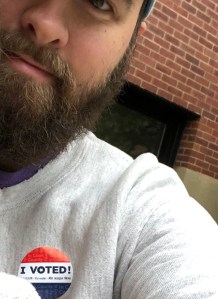
This morning, I went to the Evanston City Building, and voted. This is a pretty regular thing for me; I haven’t missed a primary or general election since I turned 18. But this year’s visit to the poll was different for me because of where I am theologically.
 My confidence in our political system has been fundamentally shaken over the last two years. Whereas I used to be an unabashed political progressive – someone who majored in political science, wrote a regular politics blog, ran for office, and worked for multiple political campaigns, all before the age of 28 – I have evolved significantly, both politically and theologically, since the election of 2016.
Now, obviously, the result of that election has a lot to do with that. No longer do I subscribe to the idea of a constant upward trajectory towards more and more justice, a la Dr. King’s “moral arc of the universe.” No longer do I believe in the inevitable push of democracy and the liberal project in the Western world to ensure progress and justice. The decision this country made in November of 2016, and the attendant racism, bigotry, hate and regress that has gripped us ever since then, has profoundly shaken my capacity to retain hope for a better political future for my country. In short, I just don’t believe any longer that progress if a surety. Descent into nationalism and fascism is just a likely.
As a result of this, and as a result of being a theologian, I have been searching theologically for answers to my despair. I have come to a place where I understand Christian political engagement as necessary, but as also requiring now a different rationale for action than that of progressive political activists. What I mean is, our work for justice as the church doesn’t mean the same thing as our work for justice as Democrats.
This theological movement has soured me on secular political engagement, and on forms of Christianity that map to it. I no longer so abashedly identify as a Democrat, or a progressive, or a liberal, or a socialist. Rather, I am less hesitant to call myself, plainly, a Christian, and let that define me. And with that, I have embraced more fully a theology that centers of Christ, as the fullest revelation of God, and as the setter of terms for Christian engagement in the world. I read Hauerwas and Willimon’s Resident Aliens, which has greatly shaped my views of the Christian role in the world (more on this in future blog posts) and edged more into the postliberal camp. In my academic work, I have been focusing on theology done for impoverished rural whites, who voted dramatically for Trump, and thus my theology has been shaped in a way that is trying to make it relevant for this context. Part of that is realizing that the liberal project at work since at least the Enlightenment has failed, and democratic society is not the highest end of human achievement, not when we know there is God’s Kingdom out there waiting for us.
All of that to say: I no longer think my act of voting this morning was an entirely noble act. Not because voting in a democracy (no matter how much of a poor shadow of that term it may be) is a bad thing in and of itself, but because I honestly think that many of the choices I made were not terribly consequential or represented a real choice in the end for the vast majority of people.
There are deep, structural problems with the assumptions made at the foundation of American society, problems that are not even going to be addressed, much less fixed, but the simple binary choice of Democrat or Republican. We have to ask questions and demand answers about our society that reject that binary; questions about the shape of government, about the damaging role of free market capitalism, about the concentration of power and wealth in the hands of a very few at the mortal expense of so many. For me, honestly, what we need is a complete dismantling and restructuring of society, because the way it is now is crucially flawed and failing.
As a Christian specifically, I see hope in the church, in the example of small communities, built around shared values and love of neighbor, doing work because of Christ, because of our salvation, because of God, and not for any other reason. Justice and rights and equality are important only insofar as they create disciples via the liberating of all human beings from the bonds of death, whatever shape those bonds may take in our world.
So, why did I do it? And why do I think you should go vote to, if I do ultimately think it’s a bit of a fool’s errand?
I still vote, and I want you to vote as well, because we live in the world as it is, and not as we hope it will be. We have to contend with reality right here and right now. And that reality includes structures of power and oppression that afflict those on the bottom. Refusing to engage, even in the engagement is in a system that has faulty assumptions that under-gird it, is to abandon those we are called by Christ to remember. To refuse to go vote as a citizen in the American democracy is to relinquish one of the few levers of power we have right now to effect even a small measure of change in our society. No, I don’t think, for the most part, there are huge differences in outcome between the D and the R on the ballot. But, there are differences, no matter how small, and we need to recognize that.
Now, what I don’t want you to take from what I just said is that I don’t think the very real differences between Democrats and Republicans on such important issues as police violence in African American communities, or the legal recognition of LGBTQI+ folks, or the fate of 11+ million illegal immigrants in our country, as small and thus the fate of those folks as potentially inconsequential. Precisely the opposite: those are huge issues facing very vulnerable communities who under our present administration are being hurt in real, concrete ways every single day.
What I do mean is this: voting isn’t enough for those communities. Facebook petitions aren’t enough. Marching isn’t enough. As Christians (and that’s who I’m writing to here) none of that is enough. What is required of us is to witness to the in-breaking of God’s kingdom in our world, and that means asserting the innate goodness, the Imago Dei, in every single person. It means engaging in acts of self-sacrificial love in public. And it means, most crucially, finding our story, and their story, in the broader story of God, and living like it.
I vote because it’s still important. But voting isn’t our duty as Christians. Loving is. And you can’t love what you don’t know. You can’t love an abstract idea, or an ideology. You can love your fellow human beings, only by being in relationship with them, seeing their humanity, and acting on that love at each moment. It’s not sexy, like an #ivoted selfie or protest march. But if you want results, this is where we begin.
So go vote, please. This is, relatively speaking, a really important election. Politically, we can’t let the forces of bigotry and hate continue to set policy in our country. But then, don’t stop. Don’t think that my submitting your ballot, and posting about it on Facebook, you’ve done your duty. You’ve barely even begun. You are Christ’s body in this world.
It’s time to start living like it.

 I just finished Nancy Isenberg’s White Trash: The 400-Year Untold History of Class in America this week. If you, like me, are interested in how we got to the moment we are in politically and socially, then I can’t recommend Isenberg’s walk through the history of the lowest class of whites in this country, referred to alternately as “white trash”, “rednecks”, “trailer trash” or a whole other host of terms she recounts.
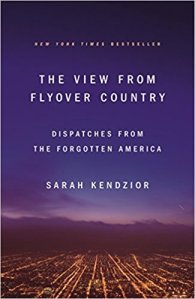 I also read the entirety of The View From Flyover Country, a book of essays by journalist Sarah Kendzior. Drawn from her work at Al Jazeera, the essays, while not necessarily useful for my thesis, were enlightening and infuriating all at once. The essays were written between 2013 and 2015, and provide a snapshot of the ways working class people were, and continue to be, left behind. I do recommend it.
 This blog clearly shows that. The number of original blog posts, rather than reproductions of school work, can be probably be counted on two hands over the last 2 years or so. I’ve alternated between feeling bad about this and not caring. Between energies spent elsewhere, and ever evolving feelings like about the political scene and my response to it, finding things to write here has become harder and harder and less important.
 Justin DaMetz