
Trigger Warning: sexual abuse, pedophilia, pornography addiction. Practice self care.
I remember the first time I met Rev. Ron Robinson. It was almost exactly a year ago, Earth Day weekend, at a Sustainability Fair at Tulsa
Community College’s Northeast Campus. I was there with my then-wife, Arianna, helping her work a table for the non-profit she works for, Tulsa Hub.
The table next to us sat empty most of the morning, and we didn’t think much of it. But finally, a small, bumbling little white haired man with a bushy beard, looking very much unkempt and scatterbrained (in a good way) came in and set up a large poster board and various flyers. And also a very large box of delicious looking fresh apples, of which Ari and I partook quite eagerly. The man introduced himself and the organization he was representing: A Third Place Community Foundation. A light bulb went on for me; I had heard of Ron and Third Place throughout the Tulsa non-profit and justice community quite a few times. We were very excited to finally meet him and hear more about the work being done in Turley. He gave us a flyer of upcoming events, and we promised to drive up and visit soon.
My interest was piqued because of Ron’s association with New Monasticism and missional community, something I have long had a very deep interest in. Ari and I had long wanted to be part of such a community, visiting several examples in OKC and the Dallas/Fort Worth area. The fact that one existed in Tulsa, and that we had the opportunity to get involved, was very, very exciting.
I don’t remember my first visit up to Turley, but it couldn’t have been long after that meeting. Turley is a far northern suburb of Tulsa, and it truly is a forgotten place of empire. Full of blighted buildings and empty lots, Turley exists in a socio-political liminal space. Tulsa has a combined city and county government structure. Turley exists outside the bounds of Tulsa city limits, but still within Tulsa County, and combined with it’s low income, mostly minority population, it gets very little attention from city hall. Services are almost nonexistent. Much of the town is without consistent running water. On top of this, “North Tulsa”, that area north of Highway 412 and of which Turley is a part of, has a distinctly bad reputation in Tulsa. This is supposedly because of high crime and drug problems, but in reality, is more related to the fact that most of the people who live north of 412 have black and brown skin. The same fears, prejudice, and racism that lead to the Tulsa Race Massacre of 1921, the deadliest race-related terrorist activity in American history, still drives the attitudes of those in mid- and south Tulsa towards North Tulsa.
In reality, North Tulsa is a beautiful and diverse place. It certainly has it’s issues, as any place does, but many of these can be traced to structural problems caused by a lack of attention from the powers-that-be. Turley, in particular, despite its blight and poverty, is a beautiful place. Located on and around Turley Hill, it is only 10 minutes from downtown Tulsa, and yet feels rural and alive and like a community.
Ron and A Third Place played a big role in this. A Third Place was founded as an organization in Turley, and of Turley, made up of people from Turley, working to make Turley a beloved community. It embraces the ideal at the center of missionalism, that the job of revitalizing the lost places of empire is with the people in those places. Colonialism – good intentioned white folks from the suburbs coming in on the weekends to build schools and clear brush – doesn’t work to build authentic, organic community. Only the people who live in a place – who know it, and feel it, and experience all it’s aspects and nuances and quirks – can do that. Only the people there know what is needed, and only if they lead and irect the work being done will it be sustainable. Those of us from those suburbs, who want to be involved, must commit to moving to these lost places, and not playing the role of white savior, but instead must listen to the community leaders, follow their lead, and offer our expertise and skills where needed and when asked for.
This flows from a very distinct Christology, focusing on the example of Jesus as someone from a lost place. Jesus didn’t commute to rural, poor Galilee. Jesus lived there, was born and raised. Jesus had an impact because he knew what his people longed for. And he called his disciples to a form of missionalism; he called them to live and work among their people, build them up, make them their own leaders. In this process would they be building the Kingdom of God that Jesus envisioned and spoke so often about.
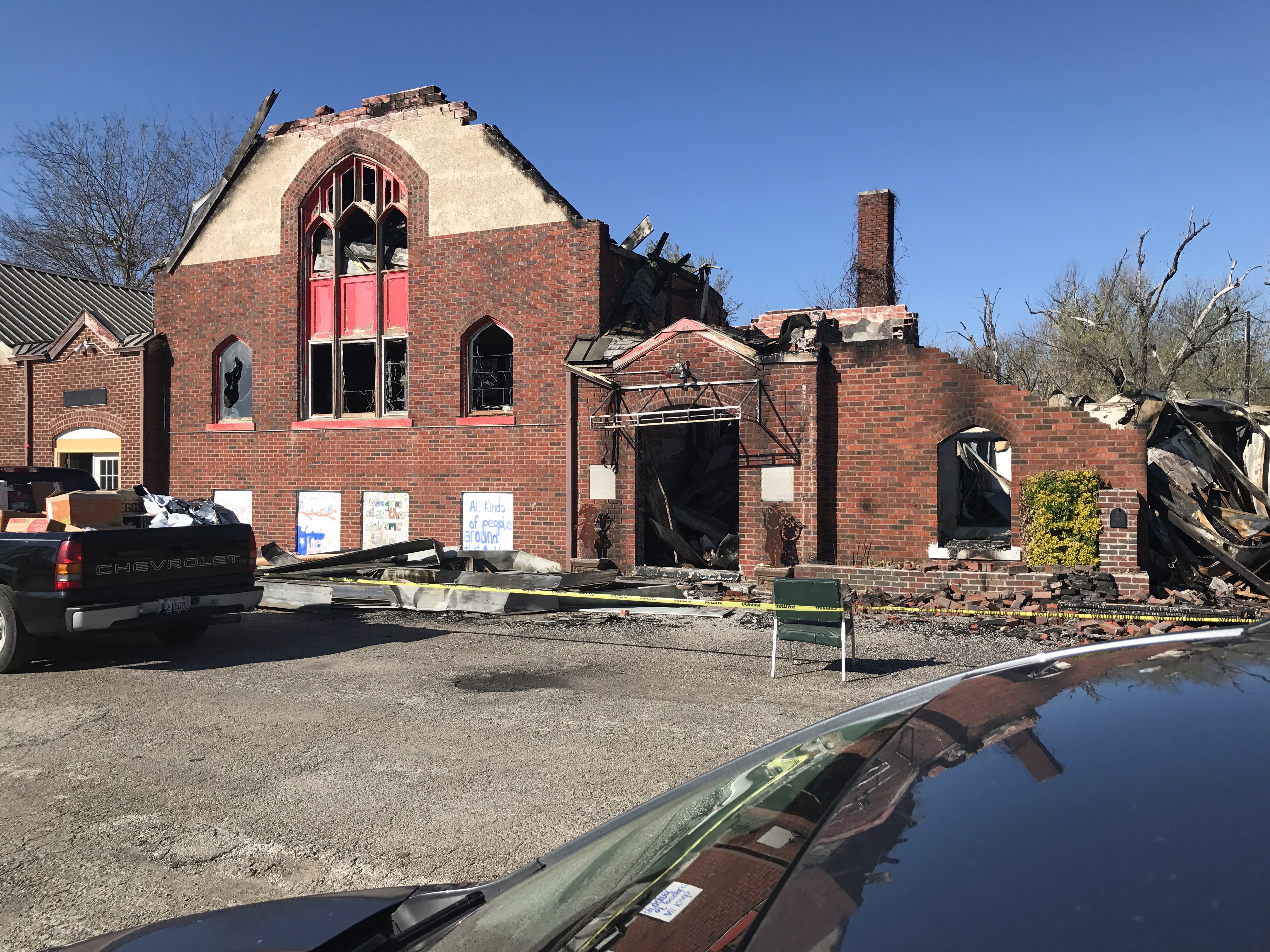
This work – the work of Kingdom building, of reclaiming a lost place, of empowering human beings to make the change they need – is what attracted me to Turley and Third Place. And at the center of it all was Ron, a pillar of the Turley community he was born and raised in. Third Place was housed in the old Methodist church, built nearly one hundred years ago, abandoned more than once, old, creaky, decrepit, but reclaimed. One of my favorite things was to listen to Ron talk about that old building, how he remembered growing up there, his grandfather’s funeral, his parent’s wedding photos, the choirs and preachers, the predominantly black Baptist church that filled the space for a while, the dreams Ron had for that building when he bought it and started working on it, and made it a semi-usuable space again.
Oh, it was far from finished. The basement, where most of the classrooms were, was still pretty bad, damaged from years of flooding. The bathroom was….interesting. The adjacent south building, a large open space reminiscent of a fellowship hall, was the on-going project, and was only finally made useful late last summer. But the main space – the old sanctuary – was a wonderful and beautiful place to be, with beautiful old stained glass, original to the building, and a large mural on one wall, hand painted by local kids.
Ari and I got quite involved with A Third Place and Ron. We started spending Sunday evenings there, worshiping with Ron and his wife and the few other people who came around, in the form of a shared meal and communion and a capella hymns. We dreamed of starting a real “Dinner Church” model there. We got to know Ron’s co-pastor quite well, and were so excited for the weeks in which a Social Justice Intern, a college student from Minnesota, was there. We rejoiced when the south building was opened. We spent long hours in the garden park, a community garden manned and worked by the locals. It was a full square block of town, up on the hill, formerly the site of abandoned, blighted houses. Ron had raised the money to buy them, then had them all torn down and started the garden. He had just overseen the construction of a beautiful green house, funded by a grant, and had won another grant to begin building a hoop garden. At the back of the lot was beautiful children’s garden, maintained by local youth. On July 4th, we spent the evening with local resident in the garden park, watching fireworks from all over Tulsa from our vantage point up on the hill, and eating grilled hamburgers and hot dogs. Our two children, ages 3 and 1, were loved and welcomed by the community, and had a variety of play mates. It was the authentic, intentional community we had been looking for. It was amazing, and messy, and real, and beautiful.
Ari and I dreamed of moving to Turley and becoming part of the community. We talked with Ron, and he helped us look at a couple of different homes. One in particular, the parsonage of the local Methodist church being rented out, right across the street from the garden park, was especially promising. But the timing fell through, and our lease at our current apartment was up before the house was ready. We settled for a bungalow northwest of downtown, and hoped to stay involved.
But life had other plans. I was in school full time at this point. I was also working two jobs, and Ari was also working and going to school. The kids were growing quickly. And in the midst of it all, Ari and I separated. We disconnected from Turley. I felt guilty about it, knowing Ron had hoped Ari and I could take on more involvement with A Third Place. But I just couldn’t do it all, and so I stopped up to Turley. Part of this was also driven by some concerns about the long-term sustainability of the project. I didn’t want to locate to a place with that kind of uncertainty.
The new year of 2017 brought new intentions of being involved. On my own, I wanted to dedicate a small portion of my free time to going to Turley and getting involved again. Then the fire happened. About a month ago, over night, a electrical fire was sparked. The old church building burned, almost a complete loss. All of the books and furniture, the reclaimed space, the food pantry full of food – all of it gone. It was devastating.
And yet the community rallied. Thousands of dollars were raised, volunteers were at the ready, and Ron carried on with the food pantry and everything else, despite the destruction. The south building escaped most of the damage, and plans were made to move most operations there. The fire also made me resolve to stick to my commitment to get involved again. Help was needed now more than ever, and I was determined to be a part of it.
So yesterday afternoon, my heart dropped when an email arrived in my inbox from a colleague. The title was nondescript, but from the preview on the lock screen of my phone, I could just read part of the first sentence: “I just received new that Rev. Ron Robinson…..” I dropped what I was doing and opened my phone, fearing the news that Ron had passed. In many ways, the news was worse.
Yesterday morning, Ron was arrested at his home in Turley as part of a child pornography sting. The charges were possession with intent to view, and stories of his involvement in an online chat room circulate. According to news reports and the indictment, Ron confessed it all, and much much more. As far as we know, no physical abuse happened. But some really terrible stuff was detailed, in terms of internet viewing and fantasizing. The details are too much to think about, much less write about or even link to.
Needless to say, the progressive Christian community in Tulsa, a tight knit group of wonderful people, is devastated. We are reeling, shell shocked, in total disbelief and grief over the news that this man that we all loved and respected, that we all worked so closely with, could be capable of such evil. I couldn’t believe that this man who I had spent so many hours with, and more importantly, who had spent so many hours around my children, could be at the same time fantasizing about terrible, horrible things. It’s too much to bear. It’s the kind of thing that shakes your trust in people, especially when it concerns your children.
This is a time of grieving. So many vulnerable people put their trust in Ron. So many colleagues looked up to him, and admired the work he was doing. We thought we knew him: unkempt, kind, a little crazy, but in a good way, a man committed to building a better community in his hometown.
But apparently we didn’t know him at all. Or maybe, we didn’t fully know him. Because his terrible acts and thoughts, the hidden side of him, exists fully alongside the good he did in the world. It’s almost incomprehensible to me, and to those who knew him and were involved in Turley, to imagine these two personas existing inside one person.
Part of healing from something like this is finding some measure of understanding. Not understanding in a sense of forgiving or excusing; personally, I feel so betrayed, by a man I trusted, who I brought my kids around, and I don’t know that forgiveness is something I’ll get to. Maybe. Who knows.
But what I said earlier, about having my trust in people shaken, that’s not a good thing. Because I ardently believe that all human beings are made in the image of God, are carriers of the Imago Dei, and thus are imbued with an inherent goodness and worth and dignity, which can never be taken away, no matter what terrible things happen. And all those people out there, who have done nothing wrong, they don’t deserve to lose my trust because of the actions of one sick man. So finding a measure of understanding is important, because it helps us know that things happen like this for specific reasons. They aren’t random. People aren’t just evil.
Pedophilia is a disease. Pornography and sex addiction are diseases. They are diseases in the sense that they aren’t inherent to human beings. Babies aren’t born pedophiles. Something happens, that infects the brain, messes with it’s wiring, and people do terrible things. They suffer from addictions focused on dehumanizing and sexualizing other human beings.
The hard part is that these things are also choices. People with these diseases still have to make the choice, each and every time, to act. And when they do, they put others and themselves at risk. In an age where access to violent and illegal sexual content is easy and impersonal, via the internet, the choices are even easier to make and harder to resist.
Affliction is a good word to use here. Affliction of the soul of these people who act out in these ways. Affliction of those who are victims of the actions. Affliction of those who know both the perpetrators and the victims. It’s a culture of affliction. I don’t know what to do about it. I’ve seen some folks say it’s about early childhood, what the people who grow up into these kinds of actions experience in their earliest years. Maybe. I don’t know how we stop it, how we stop people from getting hurt. Affliction is like that.
But I know it’s not about monsters. I hate seeing that word bandied about. Not because I want sympathy for those being labeled as such, but because it is another act of dehumanization. It comes from an understandable place, one I sympathize with and want to indulge. But more dehumanization is not what we need. It’s not how we overcome this affliction. We don’t overcome it by labeling these perpetrators after the fact as less than human. We need to understand that they are in fact fully human. They are people like you and me. That’s what scary. That’s also one of the keys to addressing this affliction. We have to know that these people are around every corner. They don’t wear black hats or twist their mustaches or live in the back of vans. They are soccer moms and grandparents and roommates, and sometimes, they are bumbling old men who are seemingly trying to make the world a better place.
Compassion and justice aren’t mutually exclusive, or zero sum. We can all stand in the gray area, the nuance, we can see the humanity of Ron, we can grieve with the victims, we can try to understand why this happened. That’s really the only choice we have, if we want to beat this stuff.
We’re doing what we can here in Tulsa to cope. Our community is coming together, grieving together, providing shoulders to cry on and hot soup and hugs and love and shared disbelief. People are grieving, and that grief takes many different forms. Creating a space to grieve is terribly important, and that is something we are working to do in multiple ways.
We are also recognizing that good work is happening in Turley, as a result of A Third Place, and that work is needed now more than ever. We have to make sure that this lost place continues to be reclaimed, that the work of Kingdom building can’t be derailed by the sickness and crime of one man, no matter how central to it he was.
You can help us. A Third Place is in the running for a grant from Seeds of Change for the garden park. It needs your votes to move forward. You can vote for Turley. It’s not just a vote for orchards and hoop gardens and vegetable plots. It’s a vote for the children of Turley, who are the real victims here. It’s a vote to remind them that people love them and care about them and want them to succeed. It’s a vote to remind them that people are good, that they are good and worthy and deserve only the best.
You can come out to Turley and help us. We would love to see you.
You can support the victims of pornography and pedophilia.
You can remind your legislators that funding for mental health services, for schools, for communities, for early childhood education, for health care, all contributes to making sure these things don’t happen, and to making sure we aren’t making more lost places, and lost people.
You can hug your kids tonight. And your partner And your friends and neighbors tomorrow. You can help spread a little love and compassion into the world. That’s what we really need right now.


 Justin DaMetz