Christian love draws no distinction between one enemy and another, except the more bitter our enemy’s hatred, the greater his need for love. Be his enmity political or religious, he has nothing to expect from a follower of Jesus but unqualified love. In such love there is no inner discord between private person and official capacity. In both we are disciples of Christ, or we are not Christians at all. Am I asked how this love is to behave? Jesus gives us the answer: bless, do good, and pray for your enemies without reserve and without respect of persons.
Mark Bredin, in Jesus, Revolutionary of Peace: A Nonviolent Christology of the Book of Revelation:
I think it is fair to say that many studies of Revelation neglect to remember that John, the writer of the Book of Revelation, was above all other things, concerned to make Jesus real and relevant to himself and those to whom he wrote. John the devotee and follower of Jesus reflected on the beloved traditions of his people as well as the troubling and alarming particulars that challenged them. Yet studies in Revelation exhibit more interest in the exalted and coming Christ. I believe that this is at the cost of the Jesus who lived, taught and died. The exalted, coming Christ is indeed prominent in Revelation. But we need to understand this exalted Christ as the Jesus who live, taught and died. Christ on the throne of God is the slaughtered Lamb.
Revelation is a weird book
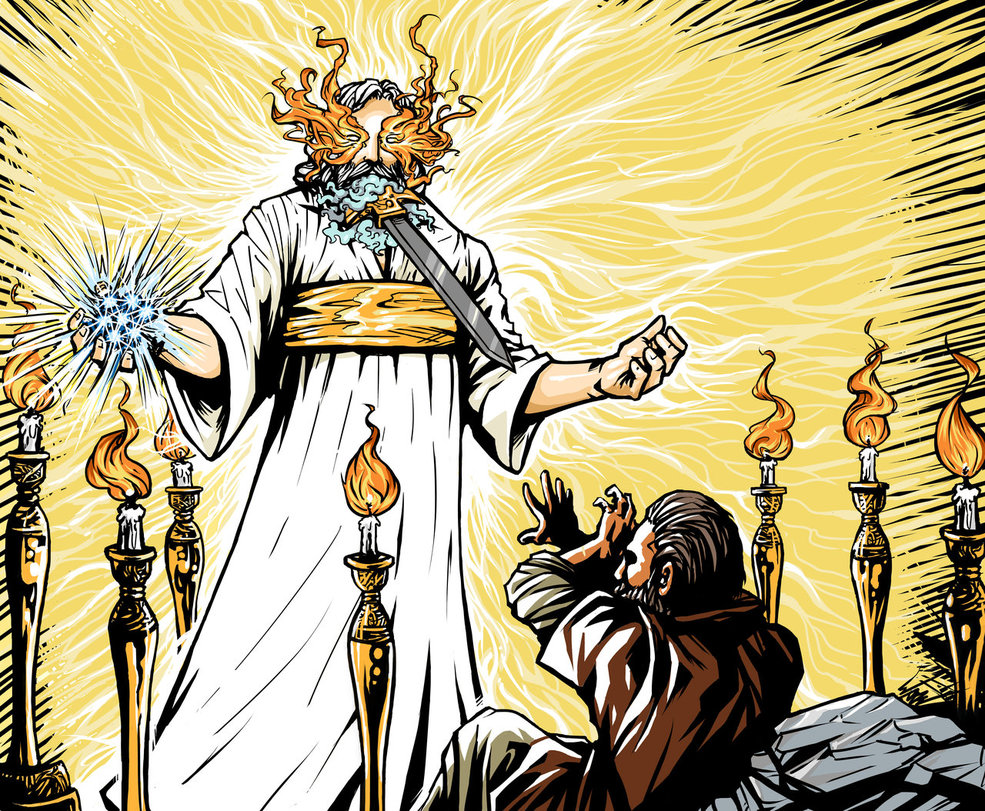
I’m reading this book by Bredin in preparation for a Sunday school class I’m teaching in February on the book of Revelation, because this really gets at the essence of what I want to emphasize: the Jesus of Revelation must be read as the Jesus of the Gospels. Too often, we turn the Jesus we read in Revelation into a warrior-god, come to bring death and destruction. A surface-level reading of the text can justify that. But, instead of reading Revelation as a blank slate of sorts, I want to read it through the lens of the Jesus revealed to us in the Gospels. There is nothing new, or groundbreaking about this approach; theologians have been doing just that for years. But, I think too often this has failed to trickle down to your regular Christian in the pews. As someone in a progressive church, I am hoping to reclaim Revelation as a vision of God’s upside down, peaceable kingdom. And that starts with Jesus.
Today’s Song: “Candle Flame/Dominoes/I’ve Been In Love/Back on 74” suite by Jungle
Another selection from my Apple Music Replay for 2024. I love Jungle a lot, and these music videos from the Volcano album are just a blast to watch (I’ve set this video to start at the 7:40 mark; this stretch of songs runs about 15 minutes, but there is obviously a lot more to this video, all of which is good as well.)
Israel’s God commands. Walter Brueggemann calls command the “defining and characteristic marking” of the true God. The most striking characteristic of communication between God and Israel is that of command-obedience. Because we live in a culture where submission to any authority other than our own egos is considered unduly authoritarian and unfair, command-obedience is difficult for us. We have freed ourselves from all external authority except servitude to the self. This we hail as freedom, though Israel testifies that slavery (particularly slavery as the necessity to do “what I want to do”) comes in many guises.
Sometimes slavery comes from Pharaoh, who ordered, “Go and get straw yourselves, wherever you can find it; but your work will not be lessened in the least” (Exodus 5:11).
Sometimes slavery comes from an economy that says, “Buy a lot of Pepsi, get a lot of stuff.”
So the issue is not if we shall live under some external command, but rather which external command will have its way with us.
Stanley Hauerwas and Will Willimon, The Truth About God, pages 26-27

 Justin DaMetz