Musing on a Year Without God

I keep seeing a story popping up on my Facebook feed, generally from liberal friends and pages who specialize in religion-bashing. Have you seen it? It’s the story of the pastor who decided to live like an atheist for a year, and on the other side, he has decided to be an atheist indefinitely. Two types of responses pop up: from my atheist friends, it’s a confirmation that God is a bunch of baloney, and if everyone would just step away from the pew for a minute, they’d see that; from my religious friends, it’s that this proves the insidiousness of the devil and the magic he works on those who stray from the straight-and-narrow, and so we all must buckle down and quit allowing so much questioning of dogma.
I’ve been habitually annoyed by the presence of this in my newsfeed, and so have consequently avoided it like the plague. So, when it appeared in my RSS feed yesterday, yet another inward groan appeared. I have a hard and fast policy of refusing the skip over any articles that come through the feed, so I knew at last I was going to have to confront this story.

It turned out to be different from what I imagined, and from what the hype made it to be. If I had to caption it for Facebook, I would say “Pastor lives as atheist for a year, then decides to be a seeker.” I know, not as catchy or click-bait-worthy. But much more in line with what Ryan Bell, the former Seventh Day Adventist who the story is about, experienced. As the article noted, even before this project, Bell was already wrestling with doubt, something perfectly healthy and normal for a Christian. His church, however, didn’t agree, forcing him to resign as a punishment for his public struggle with God (a struggle, I’m sure, that resonated much too closely with his parishioners, hence their hurry to chase him from town.)

So as I began to read this article, I also began to plan the blog post I was going to write in response: “Conservative Christian gives up fundamentalist God for a year, realizes how freeing it is to leave that stifling atmosphere.” I would go on: “Ryan Bell’s experience with atheism, contrasted with the hateful, confusing, unrelenting God of Fundamentalism he had lived his entire life with, showed him a contrast that made that God unappealing, even compared to atheism. This goes to show the problem with fundamentalism, namely, it’s not a very appealing or happy form of faith.”

But then I read this passage from the article at Religion Dispatches:

Generally speaking, the response to this decline takes the form of some sort of repackaging. That is, it is assumed that the problem is not with the substance of Christianity. At its core, the thinking goes, the gospel or “good news”—that we are “sinners” who can find “salvation” through the life, death, and resurrection of Christ, the Son of God—remains a vital truth, one which all need and ultimately seek, whether we consciously know it or not. That basic assumption remains the case even in more liberal Christian circles, I would suggest, although it often takes the form of respect for other religions and/or an emphasis on the importance of spirituality, broadly defined.

In this way of thinking, people are not leaving the church because of its central message but because of the way that message is or is not presented. Hence the calls among some in more evangelical circles, for instance, for the abandonment of the skin-deep flashiness and alienating culture war rhetoric for a kinder, more authentic—and ultimately more attractive—faith.

There is something to that line of thinking. More than a few have left churches from a lack of authenticity—and feel a great sense of loss in doing so. Such emigrants would, perhaps, gladly return if offered something better. But that way of understanding the situation can not account for what Ryan Bell experienced.

What’s striking to me is the matter-of-fact way in which Bell describes that experience. In the interviews he’s given, there’s hardly any pathos, any handwringing over the faith he can no longer identify with. Rather than rehearsing a litany of loss and pining over something more authentic, he sees his shift away from religion as an opportunity, a window into what, for him, really matters.

Christianity is something that, ultimately, he no longer needs.

Can you say, “convicted?”

So, yeah, so much for that blog post. But, this raises another interesting thought experiment. How does the faith address those who no longer need it? How do we, as Christians, come to grips with what I believe is a very real mindset, that of the person who comes to a place where they do not find a connection to the Divine through religion and thus has no use for us, even if they sympathize? How do we continue to connect to these people, our brothers and sisters?

Bell is quoted with this answer:

“I think what is far more important to know about me is the way I choose to live my life. Once people have come to terms with the weaknesses or falsehoods in their belief system, the work has just begun. How we reshape or build the narratives by which to live our lives is the most interesting part of our work as human beings. My work to end homelessness, my interest in the crises facing our democracy and our ecosystem—these are the interesting aspects of my life and work. At least, I’d like to think so.”

Did you catch that second sentence? “Once people have come to terms with the weakness or falsehoods in their belief system, the work has just begun.” For so many people, the weakness and falsehoods they find in faith are what shake the foundations they operate on. To discover that this belief system, this relationship one has invested so much into has some gaps of reasoning or logic is quite devastating many, many people.

And the church just doesn’t help. Instead of facilitating this journey of discovery and questioning, so many faith communities shun question-asking and doubt. They instead demand certainty and adherence to the absolute beliefs they claim to represent, and anything outside of that is not permitted. And so these questioning and doubting people feel repelled and pushed away by this faith they grew up in, and find no purpose in it going forward.

This all-to-common occurrence has facilitated the much-heralded rise of the “Nones,” that group of spiritual-but-not-religious people who no longer find the big answers they crave in organized Christianity. For Ryan Bell, and many others, the church doesn’t have any answers. Nor does it even have a space to try to find answers. Instead, it is standing in the way of answering them, telling them their questions are unimportant, and they are wrong for asking in the first place.

If the church wants to be a relevant institution going forward, we have got to figure out how to talk to the doubters and the questioners. Instead of acting like Ryan Bell’s church and forcing them out because their questions make us uneasy, we have to grapple with the questions as a community, find answers grounded in Scripture and reason and tradition, and allow our faith to grow and evolve. Not one of us has a fully worked-out faith. Not one of us is done growing. Whether it be questions about the acceptance of LGBT people, or the divinity of Christ, or any number of the countless things we can debate, we have to be willing to listen and cultivate questions and be okay with not having all the answers. Otherwise, we will have many, many more Ryan Bell’s on our hands, and a lot more empty pews.

The Responsibility of Free Speech: Thoughts on the Charlie Hebdo Shooting

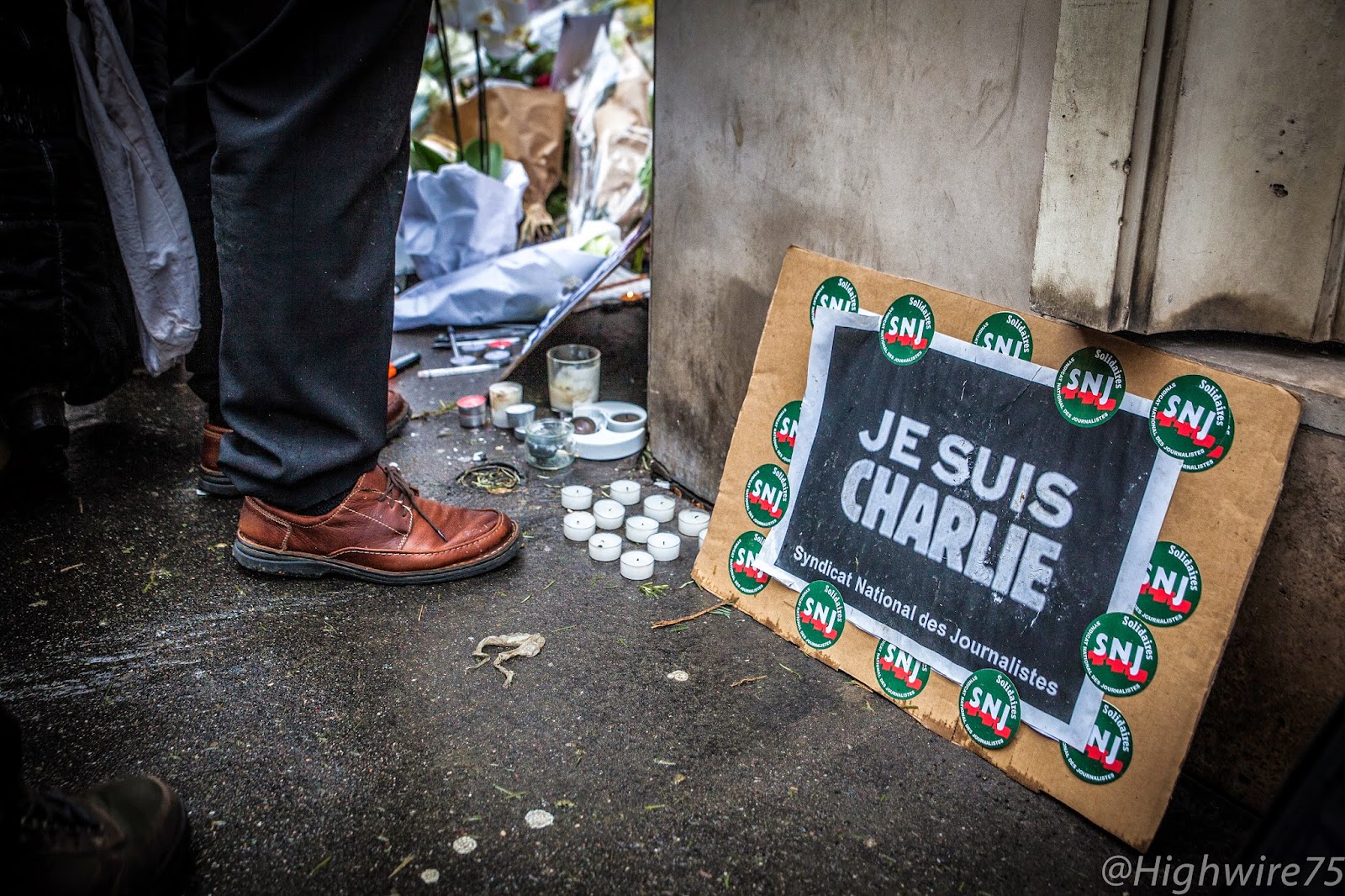
The tragic happenings in Paris came to a sort of end today, with the death of three of the Charlie Hebdo shooters at the hands of French police just outside of the city. The deaths of twelve people at the satirical magazine earlier this week has sparked an online debate of sorts about the balance of free speech and respect for religious beliefs.

By Guillaume from Paris, France (#JeSuisCharlie) [CC BY 2.0 (http://creativecommons.org/licenses/by/2.0)%5D, via Wikimedia Commons

The believed cause for the shootings was the numerous cartoons that have run in Charlie Hebdo showing the Prophet Mohammed. In the Islamic tradition, it is forbidden to show images of any prophet, especially of the Prophet, not because they are considered especially holy, but because there was always a worry that images of Mohammed would lead to his worship. Of course, the enforcement of this rule, as is the case with many such religious rules, has been taken to the extreme in some cases, causing death threats to be lodged against non-religious European cartoonists who illustrate Mohammed in the same satirical light they cartoon Jesus or the Pope. It’s not about falling into a worshipful trap, it’s more the blasphemous nature of the images that has driven the enforcement of the No Graven Images rule.

(On a related note, isn’t it interesting that many of the American Christian conservatives who have sprung to the defense of the free speech rights of the magazine would shudder in any other situation to be allied with such an irreligious publication?)

Nevertheless, warranted or not, the outrage felt by many in the Islamic world is very real, and deserves the attention of the civilized world. One way we can give that attention is by discussing that dichotomy of free speech and respectful discourse. No one denies Charlie Hebdo the right to run cartoons of the Prophet at this point. But should they be running them?

This question has caused a lot of angst over the last couple of days. Those arguing on the side of free speech have implored publications across the world to reproduce images of the cartoons that set this all off. There has even been some discussion that such blasphemous conduct is essential to the practice of free speech, that if speech that offends and infuriates doesn’t occur, then somehow we aren’t living up to the gift we have been given in the First Amendment.

Another permutation of this argument  holds that failing to run the offending cartoons far and wide hands a de facto victory to Islamic extremists, that quivering, hand-wringing liberal weaklings are giving into the radical demands of terrorists by refusing to publish the very material that so offended them.

This argument quite gratuitously ignores the value of prudence, of evaluating our actions in light of how it treats others. Such sentimental musing is dismissed as the worst of that great sin, political correctness. Exploring the responsibility of our stewardship of free speech, of the bounds which we choose to police upon ourselves, is categorized into the same class as reading Bin Laden’s declaration of jihad in wake of the 9/11; the horrific nature of the acts disclaims any possibility of understanding what provoked such a response. Never mind that we could learn how to prevent future tragedies by learning what causes such acts; so many would rather ignore all rational cause and effect in favor of keeping our own hands clean and just telling ourselves they hate our freedoms, our shopping malls, our tolerance. And so we invade their countries and mock their religious icons, and we disaffect an entire generation, and then we wonder why they lash out.

This isn’t an argument that lays the attacks on the Charlie Hebdo at the feet of said magazine; but it also doesn’t make them innocent martyrs. It’s an argument that asks that same question as above: just because we can run those cartoons, does that mean we should?

Freedom of speech in a civilized nation means more than acknowledging the limitless bounds of our rights to say things. It means speaking with a self-imposed sense of propriety or respect. It means understanding that just because we can say something doesn’t mean we should, not because a government tells us not to, but because we know that with great privilege comes great responsibility. It means that we know that tact and restraint, respect for others and their beliefs, is not a weakness or capitulation, but the ultimate example of civilization. It is the hope for a peaceful and tolerant future.

As Christians, we are called to a life full of respect and love for others. Every Christian who felt deep offense and anger at something like Piss Christ should innately understand the anger Muslims feel over depictions of the Prophet. We can acknowledge the right of persons to display these images while also calling on them to show the restraint to not do so, in the name of tolerance and respect. This isn’t giving in to terrorists; it’s coexisting with others in a diverse world. It’s self-governance in it’s highest and more virtuous form.

My prayers go out to the families who lost loved ones this week, that they might find peace and comfort. They also go out to humanity, in the hope that we can coexist peacefully and respectfully. Amen.

On Hobby Lobby and the Ongoing War on Women

I have a lot of thoughts about the Hobby Lobby ruling yesterday, most of them centered on the ridiculously wrong medical science behind the Green family’s case and the absolutely insane idea that my employer has any right to say what I do with my earned benefits once it leaves their bank account. Not to mention the heartbreak I feel for the 14% of women in this country who use birth control and IUDs for purposes other than contraception, mostly life-threatening medical conditions, who now have to hope and pray  that their right to a healthy and long life doesn’t violate their employer’s “religious liberty.” It’s disgusting.

Hobby Lobby in Ashland, KY from Flickr via Wylio
© 2012 Nicholas Eckhart, Flickr | CC-BY | via Wylio

But, I want to focus on another issue that has gained more relevance for me since this ruling yesterday morning. Let me explain it this way: when I go to a job interview, that interviewer is generally only evaluating my previous work experience, my strengths and weaknesses, and my background. My race or gender isn’t even thought of in any way. When I go to the doctor, no one questions the decisions I make with my doctor in any way. When I make a decision to work long hours despite having two kids, no one considers me a bad or deficient parent, or worries about my kids being abandoned.

The point is, as a white man in America, my identity never plays a role in the decisions and privileges I get in life. I never have to worry about any other consideration. I’m very lucky in that way.

And I’m also in a vast minority. Because, as a white Christian male, I am the only demographic in America that doesn’t deal with inherent systematic bias in life. The Hobby Lobby decision is just another point of evidence in that contention.

When I purchase health insurance through an employer, I never have to wonder if everything I select will be paid for. I can get any medical service I deem necessary. If I want a vasectomy (eliminating my own ability to reproduce) I know my employer will pay for it via my insurance, no harm no foul. When I go down to my local M.D. to get the procedure done, I will not have protesters standing in front of me crying for all the little unborn babies never getting a chance at life because of my choice.

Women don’t get that kind of freedom. Their health choices are always open for questioning and criticism. Their ability to make reproductive choices is the most hotly contested political issue of the last half-century. And now, they have to wonder if the health care they thought they were signing up for access to will still be there when they need it.

Not to mention, their ability to land jobs is tied to whether or not they are pregnant, are likely to become pregnant, or have children at home. Their ability to do a job is questioned by those who wonder if they are “tough enough” or “have thick enough skin” to “Run with the big boys.” Their mothering skills are questioned if they have the gall to pursue higher education or spend a few more minutes at the office.

And I have even mentioned that the career I have chosen, that of ministry, isn’t even open to a huge number of women in this country? Whereas I can become a minster in any denomination that I feel I belong to, women have to limit that choice. I heard a young women recently tell a story, with tears in her eyes, about how she was just a little child when she heard her newly-ordained brother preach in the local Southern Baptist church. At that moment, she felt a calling on her life, a passion to follow her brother and become a representative of the church in this world. And instead of open arms and pride, her family rejected her calling and told her she was wrong and sinful for feeling a calling from God, because she is a woman. Thank God she has found a new home in the UMC where she is welcome to follow her calling.

As Christians, we shoulder a large load of blame in the oppression and degradation of women. For too long, we told women they were too dirty and broken to be a representative of God to others, among other pursuits and dreams. Even if many of our churches have opened their pulpits to women, many others, including the two largest Christian denominations in the United States, still refuse to do so, for no other good reason than they are women, and the old men running these churches are scared too death of a woman having any authority against them in any way.

There is only one way to live a Christians, and this is with radical love, acceptance, and equality. Yesterday’s ruling, and more importantly the attitude it engenders and perpetuates toward women, is anything but Christian in nature.

The war on women in America is alive and well. Anyone who thinks otherwise is blind to the world around them.