“Christians Will Have Power”

The New York Times ran a piece this week taking a close look at a few conservative, evangelical families in rural Iowa, which tries to gain an understanding of the link between these people’s deeply held religious beliefs, and their support for Donald Trump as president. I found the article fascinating, and as someone who is also deeply committed to Christian values, very depressing and sad. I encourage you to read the piece in full, but I want to make a few comments on parts that really stuck out to me.

What first caught my eye was the title of the piece, a quote from President Trump’s 2016 campaign stop in Sioux Center, Iowa: “Christians Will Have Power.” This stuck out to me as a theologian, because Christian approaches to the seizure and wielding of political power are my primary area of academic interest. I have a robustly formed view of Christianity and political power, and this line jumped out at me because it is the antithesis of how I understand Christians to be called to approach worldly power, and those who promise it.

Here is the passage from the article detailing Trump’s statement:

Christians make up the overwhelming majority of the country, he said. And then he slowed slightly to stress each next word: “And yet we don’t exert the power that we should have.”

If he were elected president, he promised, that would change. He raised a finger.

“Christianity will have power,” he said. “If I’m there, you’re going to have plenty of power, you don’t need anybody else. You’re going to have somebody representing you very, very well. Remember that.”

The first thing that comes to my mind upon reading this is the Temptation of Christ, from the Gospel of Matthew, in chapter 4. Verses 8 and 9 read:

Again, the devil took him to a very high mountain and showed him all the kingdoms of the world and their splendor. “All this I will give you,” he said, “if you will bow down and worship me.”

I don’t know how it could be more explicit than this. I just can’t comprehend reading the words of the Gospel, and then listening to someone like Trump speak in this way, and not feel inherent opposition in these two worldviews. Its not like they are to different views which can peacefully coexist; these are two fundamentally opposite and competing views of how to approach worldly power.

Christianity is not an ideology of power. Christianity is founded upon the belief in and emulation of a Lord of laid down all power, despite all the power at his disposal, who was wiling to die rather than dominate. In the words of St. Paul, Christ emptied himself of all power. So are we called.

Granting the idea that Christians are increasingly encountering a Western culture hostile to their exercise of the faith (a theme hammered again and again by the subjects of the article), Christians are nevertheless not called to turn and attempt to wrest power away and dominate others, or to place their trust in strongmen or boastful leaders. Our Way is the way of the meek, of the humble. The example of Christ is not made lovely and desirable through the conquering of our foes, but through our willingness to love our enemies, to stand strong in our convictions in the face of the world, even if it means the loss of power and prestige and influence.

This connects to another passage from the piece that stood out to me:

“You are always only one generation away from losing Christianity,” said Micah Schouten, who was born and raised in Sioux Center, recalling something a former pastor used to say. “If you don’t teach it to your children it ends. It stops right there.”

I agree with Mr. Schouten completely. Our faith is not one based on culture or race or ethnicity. Christianity is inherited on the basis on a retelling of the story over and over, as we each live into that story, and then pass it to our children. And it continues on through the choice of our children to pick up that burden and carry it forward. That only happens through our showing the power and importance of this message we carry.

However, evangelicals in America like the ones featured in this piece seem to think and act like the continuation of the Christian faith, far from being the small work of telling the story of Christ and living it in our lives everyday in a thousand small ways, is instead the work of the federal government, and of conservative politicians. Without them, without Donald Trump, they seem to say, Christianity is doomed.

But hear me: if Christianity depends on Donald Trump and the Republican Party in order for it to live on, then the faith is already dead and gone.

I have more faith in the power of the Holy Spirit and in the example of Christ’s life than this. Our faith is not dependent on cultural hegemony, on politicians and leaders in Washington D.C. and state capitals shepherding it along. No, instead I think the insurance of the faith to these worldly leaders is in fact more damaging and dangerous to the future of the Christian witness. Our faith would be well served if it vacated the halls of power around the globe. No, we would not get to enact Christian policies and enforce our values and beliefs on others. But go read the Gospel. That was never our job anyways. When Christ entrusted us with the Great Commission, it wasn’t a command to seize power and force the conversion of millions. No, the Commission is to make disciples, which means, to make friends and be in community with them and let your life speak to the power of the witness of Christ. Christianity grew and thrived for three hundred years before it was seized and bastardized by Constantine and power the Roman Imperial machine. We do not need, nor should we desire, the imprimatur of official power.

Because when we let the faith become identified with the powers and principalities of the world, when we co-opt it to the needs of worldly political power, the message of Christ gets corrupted and twisted and becomes unrecognizable. This connects to the last part I want to highlight:

Mr. Schouten’s wife, Caryn, had walked over with the other wives. After the election of President Barack Obama, the country seemed to undergo a cultural shift, she said. “It was dangerous to voice your Christianity,” she said. “Because we were viewed as bigots, as racists — we were labeled as the haters and the ones who are causing all the derision and all of the problems in America. Blame it on the white believers.”

Christianity in America has become so wrapped up in capitalism and white supremacy and patriotism and power that even committed, church-going Christians like Caryn Schouten can no longer tell her faith apart from those things. You can see it here because she, like many conservative Christians I know, immediately get defensive and angry when people call out and fight against racism or injustice or capitalism. The faith has become so intertwined in those things that it is hard to disconnect it any longer. As I said above, it becomes unrecognizable. When someone denounces racism, and you feel like your faith is under attack, perhaps that means its time to examine your faith. Christ and the Christianity are not for white people only. And, as a movement that criticizes all exercises of power, this means Christianity must critique the power of white supremacy. If your faith intersects with your cultural and racial beliefs to a point where they can no longer be separated without those beliefs collapsing, then you need to let that collapse happen, and rebuild your faith on the Christ who is voice and friends of the weak, of the oppressed, of the hurting, of the powerless, of the people crying out for justice.

This piece from the New York Times made me very sad. It made me sad because I don’t think people like the Schoutens are bad people. I think they are committed to their faith, and passionate about it. But it made me sad to see how the Christian story has become almost unrecognizable in large swathes of white America today. I don’t know how we address that. I don’t know if we can. When I wrote my thesis last year on white Christians in the midwest, I encountered this time and time again. And despite my best attempts in that work to provide some form of theological answer to these problems, in the end, I wasn’t convinced there was an answer. I’m still not. I think the only hope the Christian faith has is for small, committed communities of faith, disconncted from the power politics of the world and living as alternative examples of how to be in the world, to do their best, and to let these other, perverted and deformed takes on the faith to wither and die, like they are on their way to doing. Maybe, after all that, the faith can grow again, not in power, but in faithfulness.

That sounds very defeatist and depressed. But that’s how the majority of public Christians make me, as someone who has studied the faith and committed myself to it, feel about those who I share the moniker “Christian” with. Maybe I’m being too hard on them. Maybe I’m being overly judgmental or failing to practice understanding. But I am trying to understand. And it leads me to judgement and anger and resignation to watching something that is very important to people die away. Thank God my hope is not founded in them.
Party Realignment: A History of Political Parties and Racism in America

Let’s have a history lesson today. History is a fascinating topic because, in studying the events of the past, you can observe the way societies and people change, and the human drama that plays out as a result of those changes. One of the reasons I love history so much is because the stories of the past – of the fall of the Roman Republic, of the American Revolution, of the tumults of Tudor England and the emergence of Protestantism across Europe, just to name a few of my favorites – are better and more exciting stories, full of pathos and intrigue, than any fiction writer could ever conceive. Reading about these great moments in history, and the people and decisions that shaped them, reveals that change is an inevitable part of the human condition, that not only do circumstances change wildly, but also people and institutions change constantly, often much more rapidly and unpredictably than we could ever envision.

I’ve been thinking about these things recently as I have watched the debate rage again about Confederate statues, the legacy of the Civil War, and the role of our two major political parties across that time. So I wanted to take a few minutes today to address that last topic. Here’s the main thing you need to understand: the parties today are very different, both ideologically and in composition, than they were 50 years ago, 100 years ago, or 150 years ago. If you think the Democratic and Republican Parties that we have today are basically the same as they were when they emerged from the Civil War, well, have I got a story for you. Buckle up.

The two parties we have today formed before the Civil War. The Democratic Party finds its roots almost at the beginning of our nation, in the wake of the Era of Good Feelings, when Jefferson and Madison’s Democratic-Republican Party had a monopoly on national electoral politics for the better part of 25 years at the beginning of the 19th century. As that single party rule proved untenable and began to crack, Andrew Jackson burst onto the scene, and he and Martin Van Buren crafted the Democratic Party in opposition to Henry Clay’s Whigs. Democrats were the party of the frontier person, of small-holding farmers, and of southern agriculturalists, including almost all of the nation’s slaveholders. As the Party coalesced over the thirty years leading up to the War, the locus of power in the Party shifted further and further southward, until in 1860, at the Party convention to select a candidate for President, the Party split across sectional lines, with Northern and Southern Democrats both nominating their own candidates for President that year (Stephen Douglas and John Breckenridge, respectively), both of whom lost to Abraham Lincoln. With the onset of the war, and in the aftermath, northern Democrats basically disappeared, and the Democratic Party became a regional party of Southern interests, as many former Confederates moved back into the party. James Buchanan, a Democrat, left office in 1861; over the next 65 years, only one Democrat (Grover Cleveland) would assume the Presidency, as their regional coalition could never amass the national political power needed to win office.

One thing that is important to know about the Democratic Party in the South is that, yes, they were the Party that supported and benefited from the rise of the KKK and other White Supremacist groups. Founded by six former Confederate officers in Tennessee in December of 1865, the group was led by former Confederate General Nathan Bedford Forrest, and one of its main goals was pushing out “carpetbagger” Republican politicians across the South. The Democratic Party supported the group, and viewed them as allies in their fight for power and white supremacist politics.

The Republican Party, on the other hand, formed in the decade leading up to the Civil War, from the remnants of the Whig Party as it collapsed, and as more Westerners joined the Union. The Party ran its first candidate for President in 1856 in John C. Fremont. From the beginning, the Republican Party was primarily concerned with stopping the spread of slavery any further west; Fremont’s campaign slogan was “Free Soil, Free Speech, and a Free Press.” Abraham Lincoln, in his 1860 campaign, doubled down on this; his election was a clear sign to the southern states that anti-slavery forces were aiming to halt and even end the practice of slavery. Their secession was a direct response to the election of Lincoln. Following the war, and the death of Lincoln, the party was largely dominated by a group of Radical Republicans, who pushed for full and equal rights for black Americans. The first black elected officials in the South during Reconstruction were all Republicans. For the next 65 years, Republicans would dominate national politics, even as they compromised with Democrats and made the conscious decision to abandon Reconstruction and build the Jim Crow system of “Separate but Equal.”

Let’s jump to 1932. While the nation technically had only two parties, in reality there were really four parties operating in electoral politics. First, you had Southern Democrats, the Party of George Wallace and Strom Thurmond and other unrepentant segregationists, a group predicated on white supremacy, Lost Cause mythology, and the maintenance of Southern power in electoral politics. Next, you have Northern Democrats, folks like Franklin Delano Roosevelt, Al Smith, and Woodrow Wilson, folks who are more interested in building up working class power in the labor union movement and protecting the gains of the Progressive Era. Third is the Liberal wing of the Republican Party, mostly concentrated in the Northeast and out West, the party of folks like Norman Rockefeller and Dwight Eisenhower and most of the Presidents of the first quarter of the 20th century – people like Teddy Roosevelt, Taft, Coolidge, Harding, and Hoover. This group is focused on pro-business policies and a strong military. They are, through and through, the Establishment. Finally, you have conservative Republicans, folks like Barry Goldwater and Robert Taft, concerned with state’s rights and rolling back the Progressive Era and then the New Deal. These four groups, for the sake of electoral success, grouped into the Parties; Southern Democrats ceded ground on labor rights and working class policies in return for maintaining the racial status quo in the South; Liberal Republicans ceded ground on national government power in return for large military budgets and business-friendly policies. This system worked well to create political stability for the better part of 60 years, albeit at the expense of black and brown bodies, who were forced into segregation and official discrimination in order for a white peace to be kept in the nation.

This carefully constructed system all started to come apart in 1948. At the Democratic Party Convention that year, as the Party re-nominated Harry Truman, Northern members led by Hubert Humphrey and Sen. Paul Simon fought for and won a Civil Rights plank in the platform, causing Southern delegates to walk out and form their own Dixiecrat Party for that election, nominating Strom Thurmond for the Presidency (Truman won the nation election any ways.) Over the next twenty years, a phenomena known as Realignment played out in electoral politics. Northern Democrats gained control of the Party, nominating Illinois Governor Adlai Stevenson in 1952 and 1956, and Massachusetts Senator John F. Kennedy in 1960, both of whom were strongly pro-Civil Rights. As this happened, and Southern Democrats left the party, they saw an opening in the nonexistent Republican Party in their states. Able to align their own state’s rights stance on segregation and racial issues with the pro-small government ethos of big business Republicans, many moved into the Republican Party, which lacked any real power in the South and was thus open for anyone willing to give it winning prospects.

A few important dates in the history of Realignment: first, in 1968, the Democratic Party nominates Hubert Humphrey, replacing a retiring Lyndon Johnson, a Southerner who nonetheless throughout his long political career had been pro-Civil Rights, culminating in his spearheading the push for the Civil Rights Act and the Voting Rights Act, and his working relationship with Martin Luther King Jr and other Civil Rights leaders. Meanwhile, Southern Democrats have one last gasp, nominating George Wallace as a Segregationist candidate who wins the South and helps usher Nixon into office. Next is 1972: in his national landslide, Nixon becomes the first Republican to ever sweep the South. Next: 1976, Democrats nominate Jimmy Carter, the first time the Party nominated a candidate from the Deep South since the aforementioned Breckenridge, in 1860. Democrats felt confident nominating Carter because Southern segregationist forces in the Party had mostly left by this point, and the few that remained were basically powerless in presidential politics. This would be the last time Democrat are ever competitive in the South. Reagan basically sweeps the South both times he won (Carter won his home of Georgia in 1980) and Republicans have had a stranglehold on the region ever since. One more date: 1994, the Gingrich Revolution, wherein Republicans win the House for the first time in 40 years by completing Realignment, as Republicans win across the South at the Congressional and state level.

So what does all this mean for politics today, for our current debates over Confederate monuments and naming things after racists and the fight for Black Lives? The main thing it means is that American history is complicated and messy and full of compromises and shifts and intricacies. It also means that if you are looking at the ideological makeup of the parties in, say, 1888, or 1924, or even 1967, to decide which party aligns with you today, you are doing everything wrong. The Parties today are wildly different from the Parties of the past. In politics, things change often, they change fast, and they change in ways that can’t be predicted ahead of time, but which have massive reverberations through time. There is a reason the Republican Party is powerful in the South and among white voters, and why the Democrats win the Northeast and the black vote, and it’s not because Democrats are still the Party of John C. Calhoun and Jefferson Davis, and Republicans are still the Party of Thaddeus Stevens and Abraham Lincoln. That rapid change over time, and the shifting of political currents and priorities, and the contingency of political circumstances at any one moment, means that politicians and leaders from 150 years ago would have a hard time finding a home in either political party today, not because those parties have degenerated or something, but because things are just different today than they used to be. The priorities of people in the past were simply different from ours today, even if some similarities across time still exist. You can’t define the Parties of today by who they used to be, whether that was one hundred years ago, or four years ago. Parties are fluid, evolving, and changing institutions, reacting in real time to the realities of group interactions within their ranks.

At the same time, this isn’t an attempt to relativize or neutralize the importance of ideas and policies in the face of difficult and shifting historical currents. In fact, I’m aiming at the just opposite idea with all of this: ideas matter. Truth matters. Historical knowledge matters, because it informs our world today. The Republican Party of today is not the Party of Abraham Lincoln and the Radical Abolitionists of the mid-19th century. That Party was rabidly anti-slavery, and it kick-started the movement that eventually coalesced into the Civil Rights movement, even as that movement left a compromising and equivocating Republican Party behind. The Republican Party made a conscious choice, in the 60s and 70s, to align itself with the interests of Southern segregationists, making a similar compromise the party had made with Liberal Republicans, to safeguard free markets and military might at the price of ceding the black vote. Meanwhile, the Democratic Party today is not the Party of George Wallace any longer. And while the Democratic Party in 2020 is far from perfect (don’t even get me started on its problems) one thing the Party has done somewhat well is embrace the legacy of the Civil Rights movement, which was left abandoned in the wake of the Realignment, and become the party of diversity and the use of federal power to ensure the civil and human rights of all people.

So here is your takeaway from this: the next time someone tells you the Democratic Party is the party of slavery and the KKK, you can look at them and say “yes and no, it’s much more complicated than that” and watch their black-and-white, highly ordered worldview start to crumble. You can educate them on the intricate and complicated nature of American political history. You can stand up and say, yes, we should take down Confederate statues and remove the names of racists from things, not because we are erasing history, but because history is complicated, and because we should honor and highlight people who have worked for justice and equality and the ideas enshrined in our Declaration of Independence and the Bill of Rights and Lincoln’s Second Inaugural Address (go read it) and Dr. King’s Letter from a Birmingham Jail (go read that, too), that we remember history in books and museums, and we honor and commemorate people by naming things after them and putting up their statues, not the other way around. And you’ll be able to say that you don’t care if the names and statues being replaced align with our Party identification today or not, because the past was a whole different place, and your mind is large enough and open enough to hold those complicated facts and ideas all at once.

Most of all, you’ll know that Party politics are only one aspect of American history, and that even as the Parties jostled and fought for power and courted different interests in that pursuit, that throughout history one thread of justice and equality has run down through time, from the abolitionists of the pre-war era, to the work of emancipation and then Reconstruction, to those who fought Jim Crow and Segregation, into the Civil Rights movement of the 50s and 60s, on into the expansion of civil rights to include other minority groups, down to today, to the on-going fight for Black Lives and LGBTQ rights today. Want to stand in the tradition of Lincoln? Don’t worry about your party ID. Instead, remember that he was a voice for radical and scary changes to the social makeup in pursuit of, in his words, “a new birth of freedom”, and look for that same radical and scary fight today, remembering always that change is scary, but it’s also completely necessary if we are going to live up to our finest ideals as a nation and people.

Policing in America By the Numbers

Let’s talk about statistics. Cold, hard, indisputable numbers. Last year, in Germany, an unusually large number of people for that nation were killed by police: 17. In the UK, last year’s number was 3. In Australia in 2016 and 2017 total (the most recent year we have data for), it was 4. In Japan in 2018, it was 2.

Last year, in the United States, the number of people killed by the police was 1,099. Let that sink in for a moment.

Now, I know what you are thinking: the United States just has so many more people than Germany, the UK, Australia, and Japan. And you are right! So, let’s look at per capita. In Germany, .2 people in every 1 million were killed. In the UK, it was .05 in every 1 million. In Australia, it was .16. In Japan, is was .02.

In the United States, 3.4 people in every million were killed by police.

I know those numbers can be hard to gauge. That disparity between the US and those major nations is HUGE. The orders of magnitude difference is crazy. And the point is this: the number of people – of any race, age, gender, or socio-economic status – killed by police is unimaginably high. It is the kind of number you expect to see in third word authoritarian and dictatorial states. To add some perspective, think about this: in 2016, the Philippines elected an authoritarian dictator named Rodrigo Duterte. Duterte ran as a strong man, promising during this campaign that he would kill drug sellers and users across the nation, and urging his supporters to commit extrajudicial killings themselves. Upon election, Duterte in essence launched a war on his own citizens, unleashing the police to commit untold extrajudicial murders of all sorts of “undesirable people.” The country in the four years since has been a human rights disaster. From June 2016 to July 2019, over 5,000 people were killed by the police without any kind of trial or due process.

Last year alone, the United States killed a fifth of as many people. Over a similar three year period, we put 2/3 as many people to death with due process as a despotic, authoritarian dictatorship.

If you value democracy, liberty, and being a beacon for morals and values in the world, this should bother you. If you are a decent human being, this should bother you.

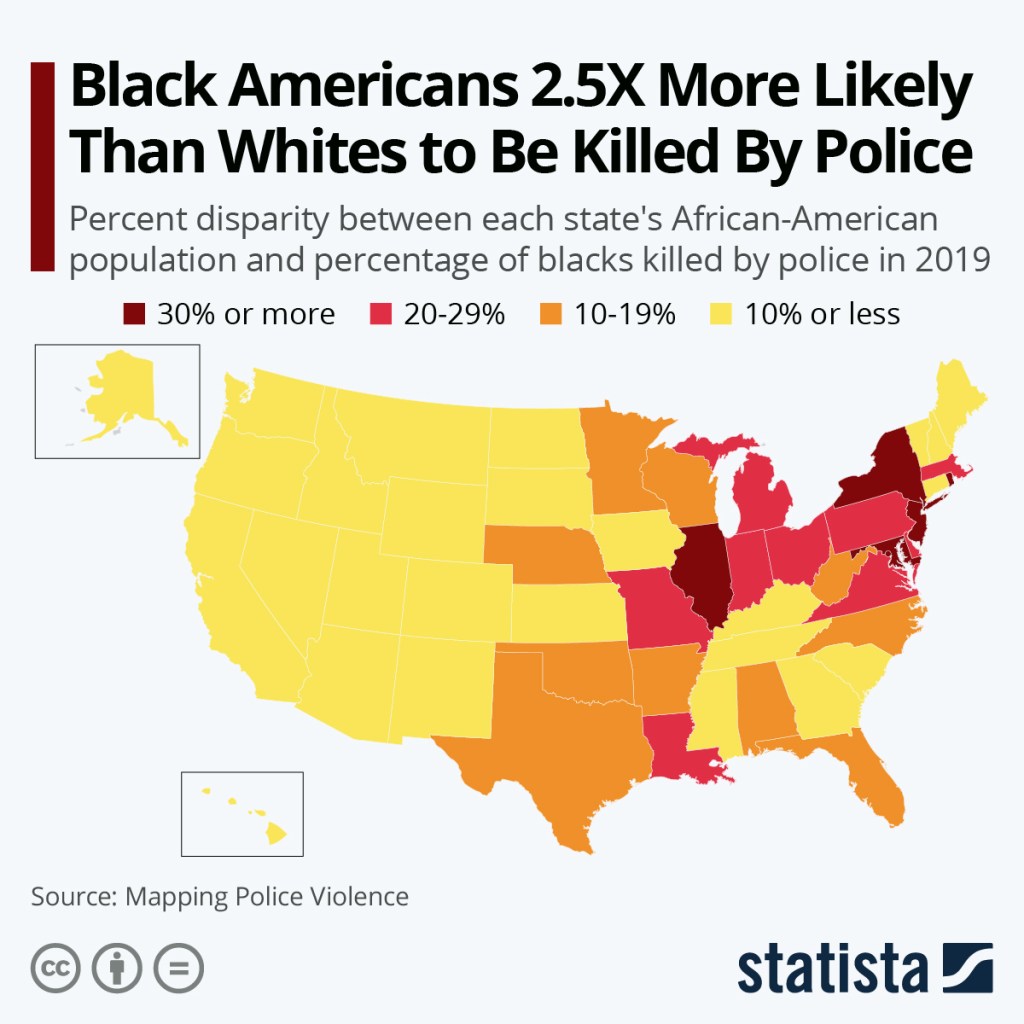
Let’s dig deeper. Out of those 1,099 people killed by police last year, 259 of them were black. That’s about 24%. Meanwhile, the US population is about 12% black. In the same year, 406 white people were killed by police. That’s more people! And, as a percentage, 37% of all people killed were white. Still more! The nail in the coffin for Black Lives Matter, amirite?!

The US population is 72% white. We white folks make up ¾ of the people in this country, but only about a third of us were killed by police last year. What this means is, if you are black in the United States, you are 2.5x MORE LIKELY than a white person to be killed by the police.

Well surely, I hear you ask, this was the case because those black people were committing more dangerous crimes, right? I mean, that’s a logical assumption to make, isn’t it? But its just not the case either: blacks victims of police death were 1 ½ times more likely than whites to be unarmed. Again, think about that: black victims were more likely than whites to be unarmed, but also more likely to be killed.

All in all, whites and blacks made up a similar amount of total crimes committed in the US last year. That tells us that, in a world free from racial prejudice, victims of police brutality should also be similar among whites and blacks. But they aren’t. Blacks are, again, 2.5% MORE LIKELY to be victimized, despite not committing crimes at a similarly higher rate than whites.

Oh, and one last thing on these numbers: in 99% of cases, the police officers committing murder against those in police custody were not charged with any crime. Let me say that again: 99% OF POLICE WHO MURDERED UNARMED SUSPECTS NEVER FACED A CHARGE OF WRONGDOING.

Again, these numbers should bother you. No, wait, they shouldn’t just bother you. They should terrify you. They should devastate you. They should piss you off, send you into the streets, make you demand better from those we charge with protecting, serving and leading our nation. These numbers are simply UNACCEPTABLE.

These numbers don’t exist in a vacuum, either. To understand why people are so angry, why #BlackLivesMatter is taking off, why people are demanding real change and meaningful police reform in this country, you have to view these statistics in the context of American history. These numbers are happening in a nation that once enslaved these same black bodies. We first created professional police forces to hunt and return runaway slaves. Then, after we were forced by four years of bloody war to no longer enslave them, our country spent the next one hundred years constructing and maintaining a state-sponsored, outright system of discrimination, segregation, and terror against these same black bodies. We lynched hundreds, destroyed the livelihoods of countless others, and refused to let them exercise the full rights, responsibilities and obligations that are their birthright as American citizens. We turned the police into the tool of public repression and discrimination, using dogs and batons and water hoses and jail cells and a convenient blind eye to keep blacks in line and in their place. Then, when we were forced to dismantle that as well, we turned around and built a New Jim Crow, to quote Michele Alexander, predicated on housing and financial discrimination and the use of judicial and police power to disproportionately punish, imprison, and kill black bodies. We have elected a series of “law and order” political leaders who used the levers of legislative and executive power to twist sentencing and judicial guidelines against black bodies. We have, in short, literally done just about every imaginable thing we could come up with throughout our history to oppress and kill black people. And, in a democracy, these things have been done in YOUR name.

And you can’t figure out why black people are done with this shit? You can’t fathom why they are so damn fed up?

These appalling numbers cannot be separated from this shameful history. And that vital link is why we are marching in the streets today. Enough is enough. 400 years of history is too much. These numbers – indisputable, scientific, hard facts – are too much. Things must change. They have to change. Our future as a nation depends on it. And frankly, these numbers tell me this: if we don’t do better, maybe we don’t deserve to stick around much longer. The injustice may just be too much for our nation, already so divided, to bear.

One last note:

I wanted to take a second to break some of these numbers down by state, too. I’m going to look at six states/territories that jump out on this map: Washington D.C., New York, Illinois, New Jersey, Maryland, and my own home state, Oklahoma.In D.C., the population is 50% black, yet blacks make up 88% of those killed by police.In New York, the population is 16% black, with 37% of police deaths being black.In Illinois, those numbers are 14%, and 53%, respectively; in New Jersey, 13% and 46%; in Maryland, 30% and 50%. And finally, right here in Oklahoma, only 8% of our state’s population is black. Yet, blacks make up 40% of those killed by police in our state. FORTY PERCENT! That’s insane!

Resources

https://www.statista.com/chart/21872/map-of-police-violence-against-black-americans/

https://www.channel4.com/news/factcheck/factcheck-black-americans-commit-crime

https://mappingpoliceviolence.org/nationaltrends

https://www.aljazeera.com/indepth/interactive/2020/05/mapping-police-killings-black-americans-200531105741757.html