Christian Nationalism is Heresy

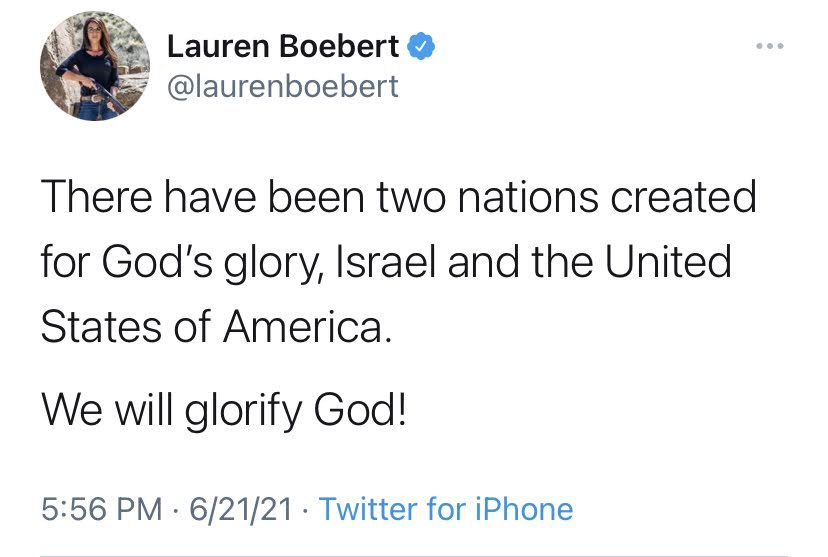
Looking for a good example of the heresy of Christian nationalism? Rep. Lauren Boebert has you covered:

Gross.

This is your periodic reminder: God does not favor any nation-state, or any people born or living in any nation-state. Neither America or the modern nation of Israel is any more special that any other country, and certainly not any more holy (just look at both nations’ track record on human rights and violence, especially the on-going apartheid-style oppression being visited on Palestinians.)

All human beings are equally loved by God, regardless of which arbitrary, human-drawn lines they live behind. America does not have the market-cornered on it, and as a matter of fact, I would caution Christian nationalists: y’all are well beyond the boundaries of what could be termed “orthodox Christianity.”

Holding on to Dr. Seuss

Some thoughts about the Dr. Seuss kerfuffle that we should try to hold in our heads all at once:

  • The images in the six discontinued books are undeniably problematic, racist caricatures. To continue to go on acting like they aren’t is dishonest.
  • No one “cancelled” Dr. Seuss. The decision to stop publishing this six (rather minor) titles was made by Dr. Seuss Enterprises, founded by Seuss’ late wife.
  • Dr. Seuss was a visionary author and artist who was also a product of his times. His work as a political cartoonist, and his interest in social commentary, inevitably meant he was addressing controversial and popular topics, especially in the political work he did around World War II. Like many cartoonists and authors at the time, he caricutured and ridiculed America’s enemies in the war, especially the Japanese, in ways that today are clearly racist and unacceptable. However, judging a man who died over 30 years ago, and who worked in the middle of the last century, by today’s standards is unfair to him and a poor way to address art created in the past. Are these images problematic as they are observed and interpreted today? Yes. Does this make Dr. Seuss an unredeemable figure for us to learn about and from today? No.
  • Dr. Seuss was – and is – a powerful voice for a progressive, peaceful and clean world, who wrote against racism, bigotry, war, isolationism and pollution through out his life. I’ll quote here from his Wikipedia page:

Geisel made a point of not beginning to write his stories with a moral in mind, stating that “kids can see a moral coming a mile off.” He was not against writing about issues, however; he said that “there’s an inherent moral in any story”, and he remarked that he was “subversive as hell.”

Geisel’s books express his views on a remarkable variety of social and political issues: The Lorax (1971), about environmentalism and anti-consumerism; The Sneetches (1961), about racial equality; The Butter Battle Book (1984), about the arms race; Yertle the Turtle (1958), about Adolf Hitler and anti-authoritarianism; How the Grinch Stole Christmas! (1957), criticizing the materialism and consumerism of the Christmas season; and Horton Hears a Who! (1954), about anti-isolationism and internationalism.

https://en.wikipedia.org/wiki/Dr._Seuss#Political_views

Anyone who cares about these issues can find a powerful ally in Dr. Seuss and a great teaching tool in his books. We would be foolish to completely dismiss him and his work because he was a product of his times. I look forward to continuing to read his books to my kids, and in doing so, teaching them about the beautiful vision of a better world found in the work of Seuss.

forgiveness, in all its danger and ugliness

I couldn’t agree more with Alan Jacobs in his appropriately titled blog post, “grace, not abounding”:

And I get it, or think I do. If you start talking about grace people will seize it, cheaply; hell, they might not only accept forgiveness but demand it. They will abuse the gift — but that’s because that’s what we sinners do, we abuse gifts. Our God hands them out anyway. Again: Jesus asked the Father to forgive those who were hanging him on a cross. Had they asked for it? Did they even want it? Had they undergone a lengthy process of truth and reconciliation in order to deserve it? Everything about the demand for earned forgiveness makes total human sense. But it’s not the Gospel of Jesus Christ. “Bear with one another and, if anyone has a complaint against another, forgive each other; just as the Lord has forgiven you, so you also must forgive.” It’s not an ambiguous statement. 

I think most of our projects of reconciliation, when they exist at all, have it backwards. They want a long penitence at the end of which the offended parties may or may not forgive. I think the Christian account says that forgiveness given and accepted is where reconciliation begins. So if we say we are Christians and want reconciliation but do not put grace, mercy, and forgiveness front and center in our public statements, then we’re operating as the world operates, not as the ekklesia is commanded to. 

On the left, we are very inclined anymore – especially in online spaces – to refuse the possibility of forgiveness and reconciliation. Too often, extending forgiveness feels too much like ignoring or minimizing past mistakes. In a #MeToo world, this instinct is even rational.

But for Christians on the left, our orders are clear: we are called to forgive, radically and dangerously and undeservedly, and then we are called to reconcile. Jesus doesn’t really give us another option. That’s what the Church should look like. Its hard and its messy and it hurts and sometimes people will abuse that forgiveness or ignore it or relapse or whatever. But nevertheless: we forgive, and we forgive again, and we do our best to be in fellowship with our enemies and our persecutors. May we have the strength of God as we go about this task.