
Yesterday, I wrote about attending Rob Bell’s How To Be Here Experience tour stop here in Tulsa on Saturday. Today, I want to take a look at the book he is promoting.
After getting the tickets for the Saturday show from Ari late on Friday afternoon, I rushed out to Barnes and Noble and bought a copy of How To Be Here. I figured, if I am going to the show, I better read the book. And so, I did. I started it at about 6:30 Friday evening. I finished it at 6:30 Saturday morning. This is a pattern for me and Rob Bell books. (I’m really glad he said his next book is measurably longer; it will be nice to spend some time with his work.)
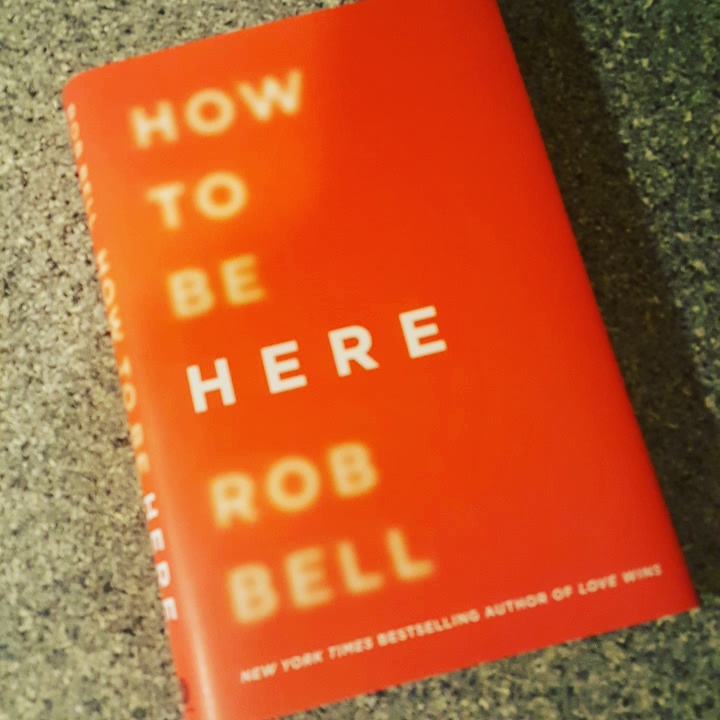 So, let’s get out of the way what How To Be Here isn’t. It is not a book about Christianity. It is not Biblical scholarship. It’s not theology. It’s not “Christian Living” (which is the heading it is shelved under at B&N.) So if you go into reading it expecting or hoping for any of those things, then you are going to be disappointed.
In the same vein, let’s get out of the way some things that Rob Bell isn’t, as well. Rob Bell is not a church pastor anymore. (Although I would still call him a pastor, albeit in a different way. He said the same in his talk.) He is not an evangelical Christian. He is not a theologian, or a Biblical scholar.
What is he? Well, I don’t want to speak for him too much. But I would say, he is a pastor in a wider sense, to a church, as he described it, without walls or a building. Instead, the church he leads is, in his words, “a group of people…….” He still guides people pastorally; he described that as a motivator for the more intimate nature of this tour, his hope to be able to interact with and hear from actual people, rather than lecturing from a stage. Theologically/philosophically, he is a universalist Christian. He still references the Bible often, both in the book and his talk, and he continues to describe his chief adherence to the Way of Christ.
And so, this book is a commentary on how to live in the world. It is a book that speaks about being yourself more fully. I hesitate to label it self-help, due to the baggage that comes with that term, but if you can think of the most generous categorization of that term, then you could call it self-help. The blurb describes it as a combination of “Spiritual wisdom with practical life advice.” I think that’s pretty accurate.
So, lets talk about this book. The premise is summed up pretty well in the title: Rob wants you to be here, present in this moment, in this life, in this world, in this place and time and context. We can spend a lot of time worrying about the future, and feeling guilty about the past, and those things can prevent us from experiencing life, from loving forward and fulfilling our potential and transcending what we think we are and are capable of.
The book is split into 9 sections, each expounding on a practice geared towards maximizing your potential and experiencing life fully. It builds, starting with “The Blinking Line,” referring to the cursor in a Word document that blinks at you, waiting for you to type something into existence, seemingly pregnant with possibility and subtly mocking you, all at the same time. It moves from there to the blank page that is the future, ready to be filled, by finding your ikigai, or calling, by developing your craft, by tackling life one thing at a time, but being willing to take big risks, by being humble enough to work your way up from the bottom if necessary, and by taking everyday as a gift, culminating in a call to living fully present in this moment, unafraid, unworried, ready for whatever comes your way, optimistic and hopeful and gracious.
Like all of Rob’s books, it is full of wit and humor and short, catchy sentences and gripping stories and illustrations. He makes short reference to the Bible in several places (reminding readers at one point that he was, after all, once a pastor.)
The whole book is captivating and powerful. The arc of argument is inspiring, and for me, much needed and well timed. Specifically, his section on taking life one thing at a time really grabbed me. Rob calls it “finding your 1.”
I’ll let him set this up:
That’s where you start. With 1.
It’s too overwhelming otherwise. It’s too easy to be caught up in endless ruminations: What if Step 4 doesn’t work? or What if there isn’t money for Step 11 or What if people don’t like the results of Step 6?
You have no idea what the answers are the any of those questions. The only thing that wondering and speculating will do is seperate you from the present moment.
When you begin, the seventeenth step is sixteen steps away. You don’t have to know how to do it, or what it is, or even when it is.
Because the first number is always 1.
Not focusing on the 1 is a huge problem for me. I am all too often thinking far out into the future, planning and stressing and unsure of how I am going to bring all this together or do that thing or figure that out.
But what this section of the book instilled in me is, I don’t need to worry about that stuff right now. It’s not in front of me now. There are plenty of problems right here to solve, and then when you solve the first one, you move to the next. As Rob’s friend Eddie says in the book, “Stop thinking about shit that ain’t happenin’.”
Another good way to think about this is from the great movie The Martian. (It’s a movie about outer space. Or course I think it’s great.) At the end of the movie, Matt Damon’s character Mark Watney is speaking to a class of future astronauts of the first day of class. He tells them, “You just do the math. You solve one problem, then you solve the next.”
You just do the math. You stop worrying about shit that ain’t happen’.
When it comes to writing, I am all to often way out in front of myself. What’s the next thing I’m gonna write? How do I follow this up? How am I gonna fill an entire page/post/book etc? And those questions paralyze me, and prevent me from sitting down and just writing what I know and what I have right now.
So now, I find my 1. What is that topic on my head today? What is that thought bouncing around? Write it down. It doesn’t have to be 1000 words or whatever. Just write down. More will come. Share it with the world when it seems right. And don’t worry about what comes next. Find your 1.
This extends to all areas of life for me. Work, home, family, leisure. I have problems to work today. Yes, we will plan and strategize and brainstorm and dream. But ultimately, we will work those problems when they get here. For now, we do 1.
Rob opened all that up for me in this book. Just that alone is big. But combined with everything else, I would highly recommend How to Be Here to you all.
Ok, so I said earlier, this is not a religious book. It’s not a book about Christianity. And that’s true. But I think there is a deeper spiritual point Rob is making, because, as he would tell us, everything is spiritual.
We have to be here, be present in this time and place and world, but that is where God is. God isn’t out in some cosmos. God isn’t beyond this plane. God isn’t out of this world. God is here, now, with us, in this world. But we miss God constantly, because we are constantly moving, and rushing, and worrying about the future, and not paying attention. God is here, and to experience God, we need to slow down and see God where God is. God is in people. God is in nature. God is in the little things that happen everyday that blow you away, or that you can’t explain.
And that’s Rob’s underlying point: be here, because God is here.


 Justin DaMetz