The Bookshelf: The Last Christians

So much of American Christianity, especially of the Evangelical and Fundamentalist varieties, carries within it a striking ideological contradiction.

On one hand, Christians in America, even if they don’t embrace the theologies outright, carry the assumptions of the prosperity gospel, and of violent nationalism. That is to say, many American Christians would affirm that God does indeed heap blessings and riches on His (because in this view, it’s almost always a male God) believers, and one particular way He does this is through the power of American military and economic hegemony.

On the other hand, many American Christians seem to think they are part of a small, persecuted, and powerless minority, strangers in a strange land that they have no responsibility for. Rather, a powerful, secular, globalist elite runs things, and is doing everything it can to stamp out American Christianity, mostly through feminism, abortion, same-sex marriage, and public schools.
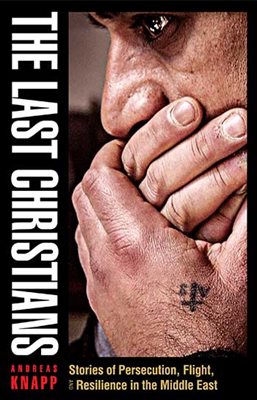
lastchristiansENThese two views stand in stark contrast to one another, and to reality. That reality shines forth in Father Andreas Knapp’s superb book, The Last ChristiansIn it, Andreas tells his own story, of meeting refugee Christians in his own hometown of Leipzig, Germany, and how that leads to a trip to Iraq, on the border of ISIS territory, and his own growing fascination with and passion for the Christian communities who live there.

These Christian communities, located now in refugee camps in Mosul and Erbil, but originally from Syria, Turkey, and Armenia, are the last remnants of the earliest Christians. Still speaking Aramaic, the language of Christ, they trace their lineage back to the early desert fathers, and even further, to the earliest churches planted by Paul and the Apostles.

Today, they are threatened by the rise of ISIS and other forms of militant Islam. Forced to flee their homes, their culture is in danger of disappearing, as families are split apart and their cultural and religious heritage is forgotten. Knapp recounts the stories of the refugees he meets in Leipzig, and on his trip to Iraq, painting beautiful and painful pictures of a people who are a global treasure, but who are forgotten by the so-called Christian West, despite politically-conveinant talking points otherwise.

At times, Father Knapp veers towards blanket condemnations of all Muslims, militant or not, in the plight of these Christians. At one point, he comes awfully close to declaring that the very nature of Islam is violence and intolerance. This kind of rhetoric can obscure the points he also makes about the millions of Muslims who have been victimized by ISIS as well.

More relevantly, he does point the finger for the rise of ISIS and hyper-militancy in the Middle East, and the destruction it has reaped for the Christians he cares about, at the truest cause: American and Western hegemony, colonialism and reckless petro-capitalism. He writes,

“I wonder what Arab countries would look like today had oil not been discovered: no interference from Western colonial powers; no billions upon billions of petrodollars for the Islamist arms build-up. What course would modern Islam have taken without the vast sums of money pumped into the construction of mosques and the recruitment of Salafist from around the world? Was the black gold really a blessing for the Gulf States and their inhabitants? How many battles have been fought in this region over access to the oil wells – in the two Worlds Wars, the Gulf Wars, and to this day?”

Father Knapp is absolutely correct in his diagnosis of the problems facing not just the Eastern Christians, but the entire Middle East today. Yet, despite our complicity in their problems, the West largely ignores the plight of Eastern Christians, to say nothing of the millions of others who face persecution. Instead, so many American Christians are narrowly focused on the so-called persecution of “Happy Holidays” and Starbucks cups and religious freedom issues. At the same time, many American Christians gleefully participate in rhetoric and military hegemony that leads to the deaths of Christians and Eastern Christian culture. Father Knapp relays one particularly relevant example:

“The lack of understanding sometimes shown by our media on this issue may have other causes too. For one thing, it is hard for us to imagine how radically the political environment inhabited  by Eastern Christians differs from our own, to the extent that they can be made to suffer as hostages for the freedoms of the West. This was brought home to me by the uproar in the Middle East over European political cartoons depicting Mohammed. Such cartoons are a normal phenomenon in free democratic societies but, thanks to our globalized world, can trigger violent reactions in other, undemocratic systems. Thus, when caricatures of Mohammed were published in Denmark in 2006, the terrorist Mujahideen Council announced that Christians in Iraq would pay the price – which they duly did.

This is what persecution and minority status looks like. Not cakes for LGBT people or state capitols free of religious imagery. It’s death and displacement. When American Christians insist on burning Korans to make a political statement, they don’t suffer consequences. Instead, Eastern Christians in Mosul and Raqqa become their scapegoats, carrying their sins into the desert.

Andreas Knapp’s book is eye-opening and heartbreaking, but should be required reading in churches across America, especially churches who feel they are being persecuted. There is a real cultural and historical tragedy occurring in the Middle East, as the remnants of the oldest Christian communities are being wiped out due to the decisions American and European leaders have made. It’s time for all of us – myself included – to wake up and realize what is happening. The Last Christians is a good place to start.

Disclosure of Material Connection: I received this book free from Plough Publishers. I was not required to write a positive review. The opinions I have expressed are my own. I am disclosing this in accordance with the Federal Trade Commissions’ 16 CFR, Part 255: “Guides Concerning the Use of Endorsements and Testimonials in Advertising.”
 

The Bookshelf: At The Heart of The White Rose

There is a paradox constantly present in times of persistent crisis. The world around us is going to hell, seemingly. Yet, at home, life goes on almost unblemished. In our modern times, this paradox is especially present. For the last sixteen years, our nation has been at war in at least two different theaters. Scientists are unanimous in their assessment that the climate is almost at a point of no return, and in half a century vast swaths of the world will be uninhabitable. Anti-democratic forces are gaining hold more and more worldwide, and hundreds of millions of people live in a state of not knowing where their next meal is coming from. And right here at home, the most extreme, right wing administration in American history is reshaping the norms of American politics in terrifying and unreal ways. 

Yet, for so many of us, life just continues to roll on. We may know about all these crises, but we are so well-cushioned – a nice home, a readily accessible food source, good schools, decent neighbors, a consistent paycheck – that its hard to feel like we are in a moment of crisis at all. You could close your eyes, and it would almost all just fade away.

However, we don’t think of moments of historical crisis in that way. Surely, in actual moments of crisis, it must be overwhelming, the constant feeling of dread and insecurity one would feel. World War II, for instance, would seem like a time when normal life would stand still, and a daily sense of extremes would dominate. This would seem especially true in war-era Europe, and probably even more acute in war-era Germany.

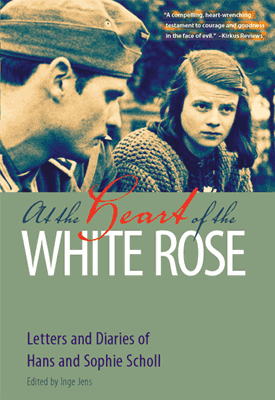
The reality, however, is almost certainly the opposite, more akin, actually, to our present reality. This feeling of detachment and normalness in the midst of earth-shattering crisis is present throughout At The Heart of the White Rose: Letters and Diaries of Hans and Sophie Scholl.

Hans and Sophie were brother and sister, alternately the oldest and youngest of a larger brood of children, growing up in the first half of the 20th century in Nazi Germany. In their early 20s at the outbreak of war on the continent, both are conscripted into national service for the Reich, Hans as a military doctor, and Sophie in the compulsory Nazi youth organizations.

Yet, neither are Nazi supporters. Hailing from a highly educated, well-to-do family, they are well-read and intellectual, and both write obliquely of their horror at the rampant nationalism and violence going on around them. Eventually, along with a substantial group of friends and acquaintances their age, they begin writing and distributing anti-Nazi leaflets in Munich. Their group is dubbed “The White Rose.” After six subversive pamphlets, Hans and Sophie are caught distributing leaflets at the university in Munich, and subsequently executed. Hans was 24; Sophie just 21.

At The Heart of the White Rose is a collection of excerpts from their letters and personal diaries, kept between 1937 and their deaths in February of 1943. And despite the wartime setting, the sense one gets of reading the letters is normalness. Without the editorial inserts between letters and chapters, one would hardly know the circumstances they were facing. Hans, being in the military, obviously speaks often of his deployment first in France, then in Russia. But these references all come admidst rumination on philosophy and religion, vivid descriptions of nature, and mundane topics such as the need for clean laundry and money from home.

Sophie, who we meet when she is just 15, is a normal teenager of time, fond of biking and boys and nature. As the war continues, you watch her become a bit harder, at times forlorn. In her diary, she struggles both with her burgeoning religious beliefs, and also with self doubt. Yet, she maintains deep friendships with far-flung friends via letter, and her inherent optimism is always there.

This is a heartbreaking book, precisely because of the mundanity of the letters and diaries. Obviously, Hans and Sophie could have never imagined all this would be compiled and read nearly a century later. But, because we know where this story is going -not just the deaths of Hans and Sophie, but also the concentration camps, the ghettos, the atrocities of war – you read these letters with the feeling you are watching the moments just before a devastating car crash in slow motion.

In the second half the book, Hans and Sophie both begin to grapple with Christianity, which seems to have become a topic of interest among the White Rose members. Hans is ever the philosopher, writing academically of theological notions, grappling with them intellectually. Sophie, on the other hand, in her diary, is much more visceral, wrestling mightily with the existence of God, and her relation to such a being. I was astounded at just how articulate and brilliant both of these amazing people were, and acutely aware of the grand tragedy of their deaths.

Both Hans and Sophie’s last letters were written the day before they were arrested, and just five days before they are sent to the guillotine. Hans writes to his girlfriend, Rose; they appear to be going through a difficult moment in their relationship, exacerbated by their distance. Hans last words on paper are a wish for another letter from her quickly. 

Sophie writes to her best friend, Lisa, that she had been playing a piece by Schubert on her sonograph, and beautifully describes the piece. “You can positively feel and smell the breezes and scents and hear the birds and the whole of creation cry out for joy. And when the piano repeats the theme like cool, clear, sparkling water – oh, it’s sheer enchantment,” she ends the letter. Less than 24 hours later, she would be in the custody of the Gestapo. The enchantment in this amazing collection of personal writings is found in the privilege of being privy to the everyday lives of these normal, ordinary heroes, and seeing that they aren’t all that different from us, that the world they were living in was not so different from ours.

Disclosure of Material Connection: I received this book free from Plough Publishers. I was not required to write a positive review. The opinions I have expressed are my own. I am disclosing this in accordance with the Federal Trade Commissions’ 16 CFR, Part 255: “Guides Concerning the Use of Endorsements and Testimonials in Advertising.”

What I’ve Been Reading (and Watching and Listening To) This Summer

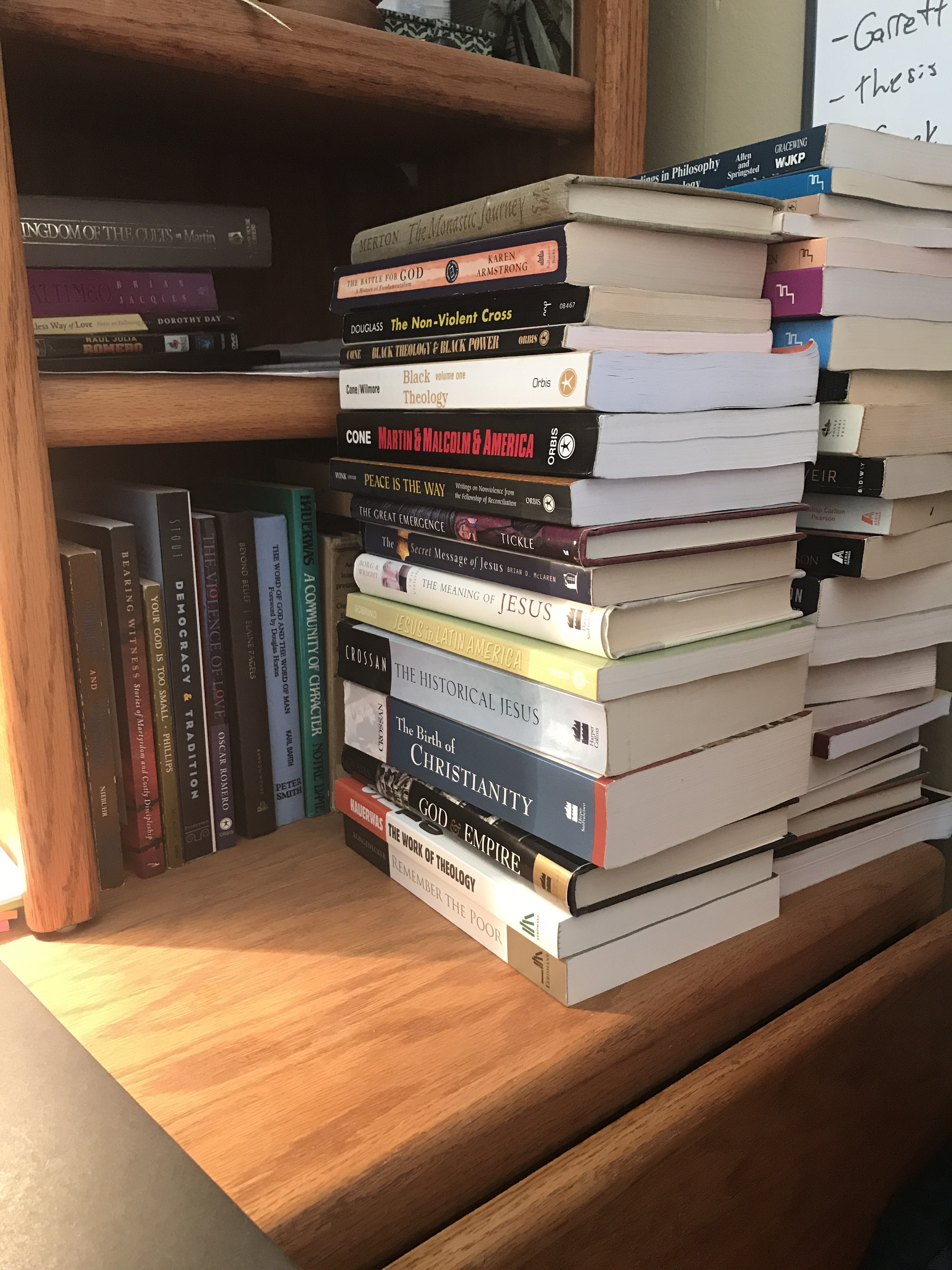
A portion of the “to-be-read” books on my desk.

One of my goals this summer has been to do a lot of reading. During the school year, any personal reading is very obviously out of the question. Being a lover of books, this means that I obtain a healthy stack of “to be read” books. This last year was especially fruitful on this front; between a pastor friend retiring and letting me raid his shelf, another friend downsizing for a cross country move and allowing the same, and just my own general buying and collecting of books, the to-be-read pile on the corner of my desk has swelled to well over 70 titles.

Obviously, getting through all of them this summer is impossible. But I’m doing my best! Here is what I have read so far this summer.

The Righteous Mind by Jonathan Haidt

Tears We Cannot Stop by Michael Eric Dyson

Sabbath as Resistance: Saying No To The Culture of Now by Walter Brueggemann

Drops Like Stars by Rob Bell

What is the Bible? by Rob Bell

The Bluest Eye by Toni Morrison

The Road to Assisi: The Essential Biography of St. Francis of Assisi by Paul Sabatier

Home: A Novel by Marilynne Robinson

The Gift of Doubt by John B. Wolf

The Divine Dance: The Trinity and Your Transformation by Richard Rohr

Sister Outsider: Essays and Speeches by Audre Lorde

Misquoting Jesus: The Story Behind Who Changed the Bible and Why by Bart D. Ehrman

How Jesus Became God by Bart D. Ehrman

At The Heart of the White Rose: Letters and Diaries of Hans and Sophie Scholl

I’m not going to get into my thoughts on each of these here, but I’m sure I will come back to them this fall. You can especially count on hearing more about What is the Bible? by Bell, the Ehrman books, Tears We Cannot Stop, and The Gift of Doubt. Also, At the Heart of the White Rose was sent to me by Plough Publishing, and I intend to write a book review very soon.

At this moment, I currently have two books I’m working on:

A Theology for the Social Gospel by Walter Rauschenbusch (which I quoted in a post last week; I imagine I’ll have much more to say going forward,)

and, We Were the Mulvaneys by Joyce Carol Oates (I’m only about a quarter of the way into it, and I highly, highly recommend you read it.)

And of course, my list is still full. If you are interested in seeing what I have on my shelf, and keeping track of what I’m reading, find me on Goodreads.

In addition to the books I am reading, I have also been working through the stacks of journals I subscribe to that I couldn’t get to during the school year. Regular readers here will be familiar with Plough, a quarterly I reference here often (they also send me books to review, as per above.) I had stacked up back issues from last summer, which I finally have caught up on.

I also took out a subscription to Jacobin, a democratic socialist quarterly, this spring, and have been reading through the back issues. Interesting stuff; I don’t always agree, but it always gets me thinking.

And, as a new student member of the American Academy of Religion, I have started receiving their journal, which I haven’t even had a chance to look at yet. (I intend to attend the Annual Meeting in November in Boston, which I’m sure I will share more about here.)

Of course, I expect to have thoughts about all three of these journals here in the future.

I don’t watch TV in the traditional way (I’m a millennial, after all) but I do engage in binge watching shows as best as I can. This last year, I worked through Mad Men finally, and got current of House of Cards. I am currently working through the Sopranos (halfway through season 4!), with intentions of moving to The Wire next.

Finally, I have been working on catching up on the Rob Bell podcast (RobCast) this summer, which is always stimulating and hilarious and wonderful in a lot of different ways. You should listen to it!

So that’s everything that’s bouncing around in my brain this summer, which is obviously going to have lots of influence here going forward. What are you reading, watching, or listening to this summer? Share with us below!