Kingsnorth and Berry

On Friday, in my final post on Wendell Berry and Huck Finn, I wrote these words:

So, too, our acceptance of these Territories in our own lives is a rejection of our own growth, as people with a place, with a purpose, and with a telos to our lives. Those things – place, purpose, meaning – all require an acceptance of reality as it is, a choice to live in this world, with love and feeling and pathos and tragedy. To escape to a Territory – to despair, or practice self-righteousness, or to abstract all around us – is to refuse reality, to refuse to be a mature people. And this has consequences – for our ability to form relationships and love properly, for our world and our environment, for our cultural and societal structures. To quote again from this essay, a passage I quoted on its own last week: “We want to be free; we want to have rights; we want to have power; we do not yet want much to do with responsibility.”

This is the point of this last week, and why I found this passage in Berry’s essay so interesting, but perhaps I would turn his image on it’s head. I think we are all mostly in the Territories; we need to escape back home. Our lives together and our world depend on us growing up, and not giving in to despair, to self-righteousness, to the tendency to abstract our places and meaning. A key element of life in post-modernity is a crumbling social awareness, and I think Berry identified why that’s happening, more than thirty years ago in an essay about Huck Finn.

Then, earlier this week, I read Paul Kingsnorth’s most recent essay on his excellent Abbey of Misrule newsletter, where he wrote this:

This left hemisphere culture: this is what we call ‘the West’, and the whole of this ‘West’, since at least the eighteenth century, has been a state of permanent revolution. Was this forged by that left hemisphere way of seeing, or was it the other way round? Who knows, but from France to Russia, Germany to America, Marx to Rand, 1789 to 1969, the aim has been the same: bring it all down. Break it all up. Pull it apart, examine the parts, put them back together in a better, more equal, more profitable, more human order. This is the left hemisphere’s way of relating to the world. In the words of Ezra Pound, Modernist poet turned Fascist propagandist (the distance between those stances was always very small) the modern West has always had one purpose: make it new, make it new.

[…]

This is what we do, here in ‘the West’: we break things. We break systems and traditions, cultures and forests. We split atoms and bust through the upper atmosphere. We break the bounds between species and sexes, we blur the lines between life and death. Our great revolution has unleashed untold energy and created miracles, but now we can see where it is going. The modern revolution, the Machine revolution, is the left hemisphere’s work. There is a kind of greatness to it, and a certain tragedy. Most of today’s ‘defenders of the West’ are defending aspects of this revolution. They will defend empire, science, rationality, progress and nuclear fission until the cows come home. They are revolutionaries themselves, even if they call themselves conservatives. But the West’s left-brain revolution will end up destroying us, and the world, if we let it.

This is first another plug by me for Paul’s excellent newsletter, which you should subscribed to and reading regularly if you too are concerned with the culture wars all around us.

But, second, I see so many parallels between the work Wendell Berry was doing in this essay I’ve been reflecting on, and the work Paul is doing in his newsletter. In fact, at several points in this essay, Paul refers to the map we live on, a map of a territory we struggle to see clearly. Both have identified the fact that not only have we done great damage to the world and the society we live in, but that we have created a massive illusion in order to shield ourselves from the damage we are doing to our world and ourselves. For Berry, these are the Territories. For Kingsnorth, it is the Machine. They are the same.

Again, read Paul Kingsnorth if you haven’t, the work he is doing is critically important at this moment.

inevitability

The excellent HBO show Succession wrapped up a few weeks back. For those who did not watch, the four season series follows the fictional Roy family, loosely based on the Murdochs and the Redstones, families made obscenely wealthy through the efforts of a patriarch in the media industry. In the show, as in real life for those families, that patriarch has multiple children, all vying for their own piece of the pie as their father nears the end of life. The show is fantastic, with amazing characters, wit and humor to marvel at, and a deep Shakespearean core to the story it is telling.

Shiv, Roman, and Kendall Roy, from Succession

One of the things it does really well is meditate on the absurdities of extreme wealth, and what it does to human beings. All the major characters are obsessed with accumulating more and more, and all of them are malformed souls, with deep personal flaws, the central of which for all of them is the inability to form human bonds. The presence of such wealth breeds a kind of cynicism and paranoia, which precludes closeness with others, because you cannot know their motives: do they love you, or your money? Better to seal it off, assume they want your cash, and keep everyone at arms length.

I’ve obviously never been obscenely wealthy myself, nor have I run in those circles. My time in politics let me into some of those circles, on a smaller level, but it was limited. However, one of the things I think the show does really well is provide a lens into a world many of us never see. And one thing that was apparent about that window, through all four seasons, is this: wealth doesn’t cover up one humanness. What I mean is, all of these very wealthy, seemingly very put together people, are just in the end, people, and pretty fucked up ones at that. They are all muddling through the world as much as the rest of us, no matter how much they want us to think they are floating above it all. I know this may be obvious to some. But I think its an important reminder, considering how badly our culture wants to lionize and even divinize the elite.

I wrote this in my recent post on AI pessimism:

The moneyed interests of the world – they are all going to get old, and confront mortality, and when we are all gone, this will all remain. The rat race everyone is caught up in – I’ll let others run it, because I have compost to turn over and weeds to pull. You can’t put that on a microprocessor, and I can’t get it delivered to my pocket. How sad for those who are trying to.

I think the rich and powerful accumulate wealth and influence and power because it feels like a kind of Fountain of Youth – immortality, or at least invulnerability, is possible is there are enough zeroes in my bank account. Or at least, that’s what they want the rest of us to think. That, and inevitability: that wealth and influence and power are inevitable, it always was on their side and always will be, and to question otherwise is to question nature itself. And this narrative has mostly worked throughout history, and in a post-French Revolution world, it has worked most effectively in America. We have never really, as a people, questioned wealth and its provenance, no matter how badly some of us have wanted to.

The Roys, at the end, being reminded of their own humanity

But, that inevitability and invulnerability: it’s all a sham. That’s what’s great about a show like Succession, or even Mad Men or The Sopranos. These are all just people, not gods and not superheroes. The inevitability, the power, the cynicism and detached nature: it’s all a show, meant to hide the fact that they are just like the rest of us, and their situation in life is not ordained from above. Because at the end of the day, you are left with Logan Roy getting confused and pissing in his closet, or Roman Roy crying hysterically at his father’s funeral, or Kendall Roy getting high in a shack in a desert in New Mexico. It’s Tony Soprano having panic attacks, and Don Draper with no real friends.

To go back to my quote above: these inevitabilities want us to order the rest of the world around them. They want us to bend our buying power and our attentional energies and our everyday lives around their needs, and to forget that we are doing so. One of the projects I’m engaged in with my writing, and with the life I am crafting for me and my family, is a refusal to do so. There is another Inevitability to bend ourselves towards, that will ultimately bend all those lesser inevitabilities as well. They can try and make the rest of us conform our worlds to the one they want to build. But all we have to do it say no. Remember, the emperor has no clothes, and we all have the power to notice and to laugh.

fake tough guys and empty corporate suits, also known as the 2024 election

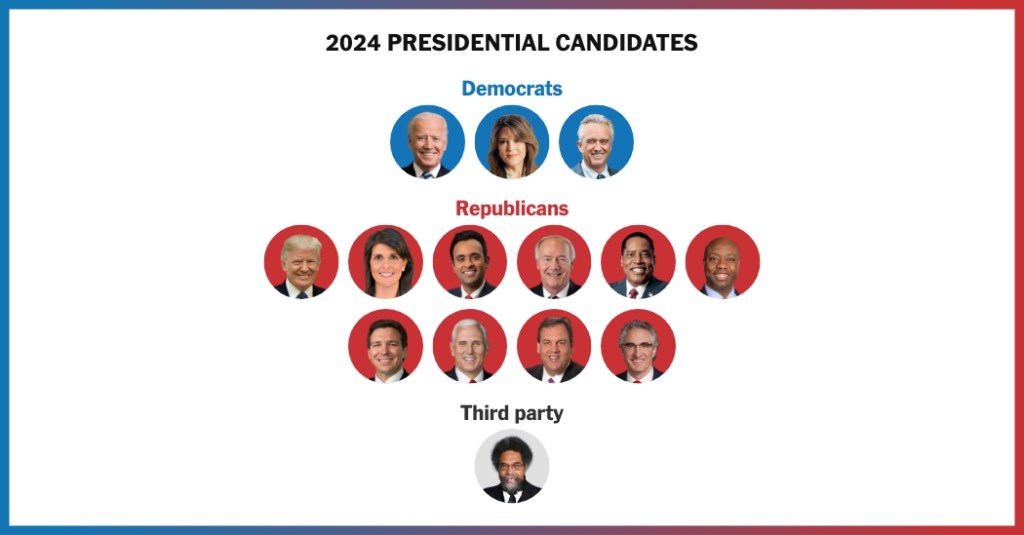
The New York Times’ current list of candidates running in 2024

What a depressing slate of candidates! Biden, Trump, DeSantis, Haley, Pence, Scott, Christie. Yuck. And now recently Andrew Sullivan, whose voice I so often respect and even agree with, is touting Tucker Carlson and RFK Jr., not as serious candidates for the presidency, but as voices that “we need both of them in the mix — for a healthier, more democratic politics.” Uh, what? I’m sorry, any vision of a healthier democracy in America does not involve Tucker Carlson. The man has spent years railing against democratic institutions, cozying up to fascist dictators like Victor Orban, and (apparently disingenuously) supporting Donald J. Trump, whose democratic instincts are lacking, to say the absolute least.

We have terrible options all around. And it’s made all the worse when you look at the actual looming threats and challenges facing our country – technology and the rise of AI; the effect of social media on our brains, our pocketbooks, our children and our democracy; climate change and the unrest it will spark, just to name 3. Do you really trust any of our current batch of leaders – all of whom are either octogenarians, plastic corporate cut-outs, or role-playing reactionary fake tough guys – to actually tackle any of these issues in any real way?

It just underlines my continuing frustration with much of my fellow left, which has become beholden to institutions and solicitous of current power structures and systems. The answers we need to the challenges we face aren’t coming from inside the system; they are out here with us. Those fools in Washington (and in our state capitals) are doing nothing but continuing to play the same bullshit political games that they want us all sucked into 24/7. Let’s all ignore them and do the actual work that we’re all gonna have to do in the end anyway when they let us down again. Let’s not just get sucked into quixotic political campaigns because the candidate self-brands as an “outsider.” And let’s not assume that we have to choose one candidate or the other to get behind, especially if doing so requires us to compromise our values. To not make a choice of a candidate is to make a powerful choice for dissatisfaction with the status quo. Politics and elections aren’t sporting events, and we aren’t fans. The future of our lives is more important than that, and we must demand better.