As you can tell, I’ve been in the midst of reading a lot of Wendell Berry so far this summer, which naturally has my mind focused on farming and rural areas and the depredations of big agriculture and urbanism. So I was especially struck by this piece by Freddie DeBoer this week, on how dense urban space are vital to the preservation of wild rural ones. Here is his argument in a nutshell:
So to be more positive here’s a pro-housing abundance messages that I wish was a little more prominent: higher housing density can actually protect the undeveloped spaces that make the country more verdant and beautiful. Increased density in higher-density places reduces building in America’s beautiful low-density places. This is good substantively and politically.
His argument continues on about how advocating for denser urban spaces – defined by vertical construction and reduced vehicle storage space – is far preferable to urban sprawl – suburban single family homes spread out on big lots. That sprawl inevitably builds over wild spaces, but it doesn’t need to be this way. If we want to preserve beautiful rural spaces – both for wildlife conservation reasons, and agriculture/rural-way-of-life reasons – we need to think differently about how we build our urban areas. This requires some top-down decision making, which many locales are seemingly quite hesitant to do, at least as long as that decision-making is more focused on reducing urban sprawl than it is restricting how buildings can be built and used in dense urban areas (height restrictions come to mind.)
Give Freddie a read for more on this debate. Matt Yglesias is a good voice as well, if you are interested in zoning and land usage issues.
Jesse Singal has a great piece out recently, highlighting a new gun control organization in Colorado called “Here 4 the Kids.” Run by serial anti-racism grifter activist Saira Rao, the group’s seemingly only goal is pushing a blatantly unconstitutional Executive Order on Colorado Governor Jared Polis. Here is Jesse with the details:
The CNN article links to another CNN article which notes that in April, Polis signed four gun-control bills into law “that raise the age requirement for gun possession and establish a minimum waiting period for gun deliveries, among other measures.” So Polis certainly is on board with reforming gun laws. Will these particular reforms reduce gun deaths in Colorado? You know me: the world is complicated and it’s hard to say. But no one can deny that the law in Colorado, as it pertains to firearms, is now stricter.
Compare that to what Rao and Here 4 the Kids are calling for: they demand that Polis sign an executive order (not pass a law approved by the state legislature) in which his office, having declared a state of emergency, would unilaterally declare “a total ban on all guns and a comprehensive, mandatory buyback program.”
Jesse Singal, “”Here 4 The Kids” Smells Like a Very 2023 Racial Ablution Grift”
As Singal goes on to note, this EO would be struck down as unconstitutional by any court with half a brain in about 10 seconds. No matter what your take on the 2nd Amendment may be, there is no common sense reading of it that would permit a blanket ban and seizure of all firearms, full stop. This is crazy.
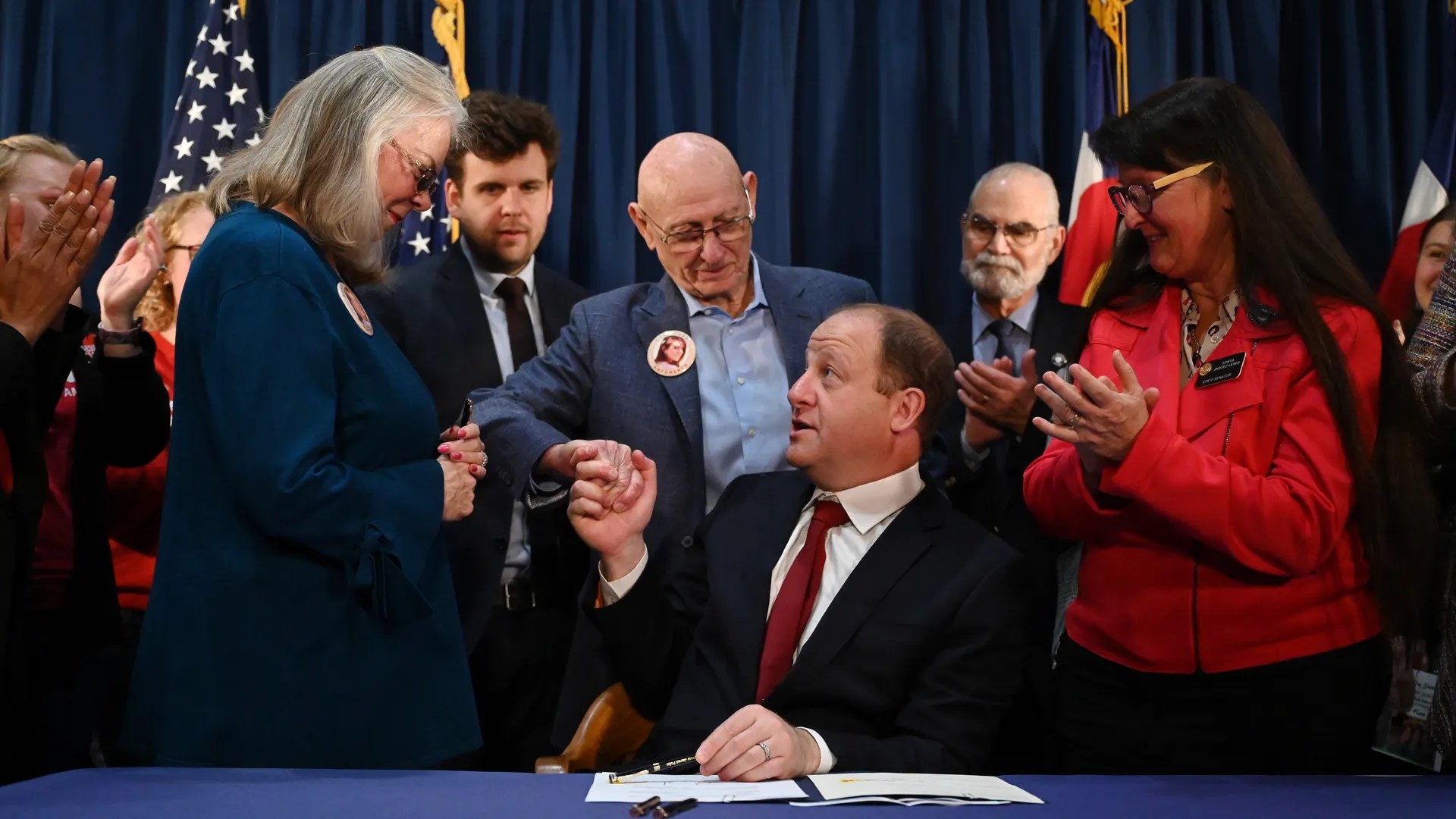
Colorado Gov. Jared Polis actually addressing gun violence – unlike some unserious people on the left.
It’s also the perfect exemplification of my on-going frustrations with the liberal/progressive/left political movement in this country, or at least, its public face. Let me qualify this by saying: I am a leftist. I would qualify as a liberal or a progressive in any accounting of political positions (although I hate both of those labels, for many of the reasons I will express here.) So I definitely say this as a fellow traveler, and as someone who definitely supports gun control and thinks guns are one of the largest public health issues in our country, not too even mention the moral and ethical issues around the glorification of guns and violence America traffics in so often.
But, if anything is every really going to be done about gun violence (or climate change, or health care, or mass incarceration, or income inequality; copy and paste this argument into discussion of any of these subject), then people on the left have got to get serious about how politics works, and even more importantly, on the indisputable fact that other people of other political persuasions and opinions both exist, and have a right to their views. To take it even further: we have to get serious about the fact that we need some of those people on our side if we ever want to have any chance of making any policy changes actually happen!
Here 4 The Kids is the perfect exemplar of how so much of the left isn’t really here for political change as much as they are for clicks and Instagram posts and virtue signaling. In what world does Rao and the other leaders of this group live? Because in this world, all political actions have an impact and provoke a reaction. And an EO banning and confiscating ALL GUNS in a state would be met with a pretty severe reaction, both in terms of immediate action and political consequence. To make this policy your only goal, especially in the face of a governor who is clearly legitimately trying to address the issue, is to not engage politics in any serious way.
And listen, I understand that posturing and position staking is a crucial part of politics. I understand that shifting the Overton Window on any issue requires visioning the world we want to see, and in some cases, advocating for things that feel extreme right now. I get that. I worked politics, and I was good at it, I have a degree in Political Science and I have a strong grasp of how this works. But this is not that kind of thing. There is a difference between strategically visioning, and just saying the most extreme thing that will get you the most likes on Twitter and more donations from gullible MSNBC viewers in Vermont. To quote Jesse again: “This is all so fundamentally unserious.”
I have disengaged politics for a few reasons. One of the main ones is this essentially unserious ways so many of my fellow leftists do politics. I live in Oklahoma. People are conservative here, by and large. Even the liberals are conservative in many ways. There is no hidden progressive majority here waiting to be activated. Nor is there anywhere else. It’s popular to believe otherwise in progressive circles, but its merely wishful thinking at best, and a willful denial of reality at worst. What that means is, we have to convince people in the moderate center, and in a place like Oklahoma, even people on the center-right, to support our candidates and our policy. Political statements like banning and forcibly seizing all guns does not do that. It makes it harder and harder to do real work around gun control. And, frankly, actions like these border not just on politically irresponsible, but ethically so as well. Gun violence is a massive issue with serious moral and ethical overtones; doing political work that claims to be addressing it while in fact almost certainly knowingly doing the opposite in order to build a donor base or online audience is ethically problematic. You aren’t doing social justice with stuff like this. You are doing just the opposite.
So, fellow leftists/liberals/progressives: get serious.
I just wanted to take the opportunity to invite you to subscribe there, if you haven’t already. It is free, and comes directly to your inbox. The project is launching into a new phase, and now is a good time to get in.
What is the project that I am engaging in on my newsletter, and how is it different from this blog?
The Radical Ordinary is my small attempt to work out my own theology, to explore the ideas and voices and works that have shaped and influenced and inspired me, and to begin to achieve some coherence
In order to find the intellectual coherence I crave, I need an organizing principle. The Radical Ordinary provides that for me. I love this concept, the tension it creates, between the idea of something being both Radical – revolutionary, extremist, uncompromising – while also Ordinary – common, habitual, traditional.
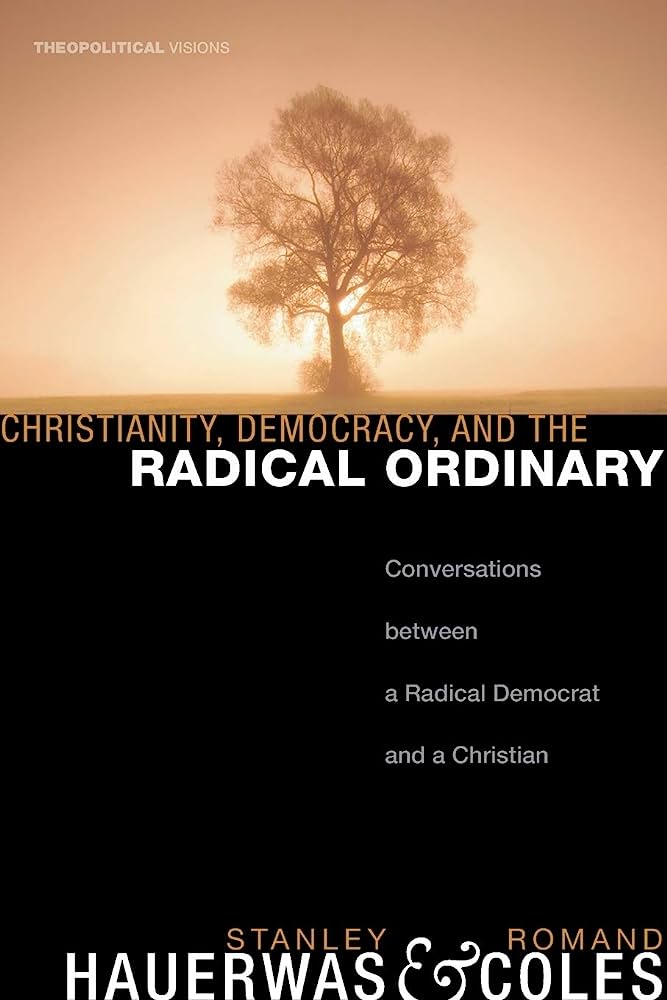
I draw the name The Radical Ordinary from the book Christianity, Democracy, and the Radical Ordinary: Conversations between a radical democrat and a Christian, by Stanley Hauerwas and Romand Coles. I first read this remarkable dialogue in book form in 2015, while at Phillips Theological Seminary. I haven’t been able to shake it ever since. It forced me down the political and intellectual road I’ve been on ever since. It forced me to reexamine my faith in traditional forms of political engagement, and my belief in the unproblematic engagement of the church with politics as the world does it, and to start asking hard questions that kept giving me uncomfortable answers. It shook me out of my unthinking political and theological assumptions and priors. It’s a book I return to often.
Throughout this project, I will be exploring a variety of ideas and thinkers – John Howard Yoder, Jurgen Moltmann, post-liberalism, liberation theology, Oscar Romero, process theology, martyrdom, Stanley Hauerwas, the Book of Acts and the Epistles of Paul – all of these, and more. I invite you to join me, to read and think and respond and challenge and share.


 Justin DaMetz