Heresy and our wild, untamed God

I shared this tweet in my Instagram story yesterday, and I got some interesting pushback from a handful of folks that I want to respond to.
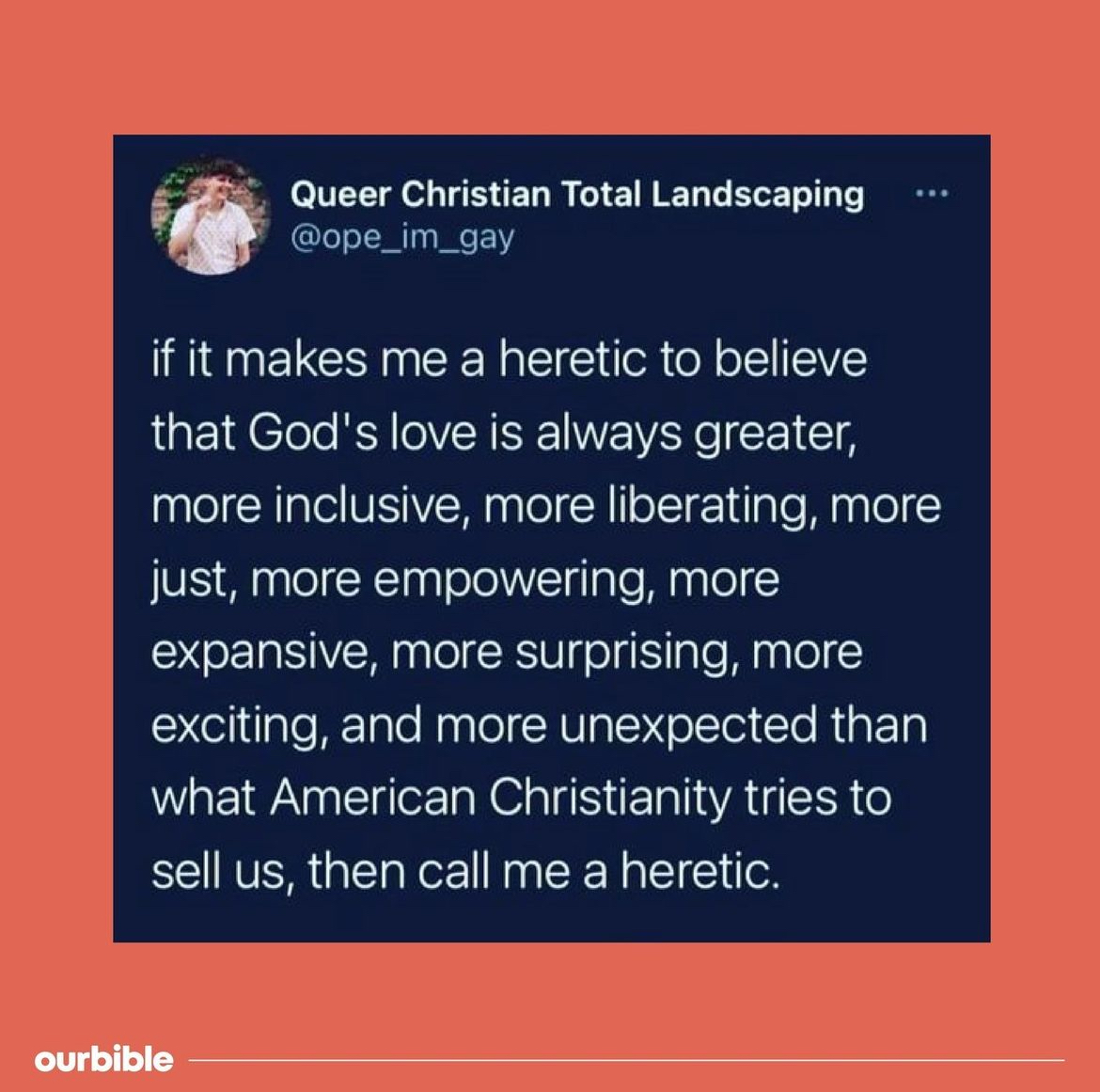
Heresy is a word created by humans. It doesn’t occur in the Bible. People created the idea of heresy as a way to designate, in the long running theological battles over any number of issues, who is in and who is out. Its a human construct that serves a role in debates over orthodoxy. It is not a God-ordained marker about any particular belief.

So, when I share something like this, I’m saying that if someone wants to label me a heretic over a particular theological belief I hold, that I can live with that. The claim heretic is subjective; its someone’s opinion about a particular situation.

And frankly, when someone wants to wield the word heretic around the act of expanding our understanding of what God’s love encompasses, it really makes me want to turn that accusation around and throw it back. Because I truly, deeply believe that if you do or say or promote anything that tries to limit God’s love, that tries to put God in some kind of man-made box or make God smaller than God could be, that’s real heresy.

Here’s why I don’t think any of this is actually heresy, or wrong in any way. The Bible says, in 1 John, “God is love.” When we say that, we can only ever approximate the reality of love that is God with our language. We can’t really wrap our head, or our words, around the capacity or the depth or the magnitude of the kind of love that is God. So, to try to limit the reach of God’s love towards human beings – to say, this person is out for this reason – is to put a limit on God, is to stand in God’s place in making a determination about where God’s love does and does not reach. We are not here to make that call, as Paul reminds us. We are simply here to live into God’s cruciform love via our imitation of Christ, and leave it up to God to make any judgments.

Same goes for just how just God is (Deut 32:4), how liberating God is (Psalm 146), how unexpected God is (2 Peter 3), or how inclusive God is (Gal. 3:28). Our language cannot comprehend the attributes of God, it can only make vague gestures in that direction. So let us beware placing limits on the good things about God and God’s love for us and God’s desire for the world and for us. Always, always, always err in the direction of more love, more justice, more inclusion, more mercy. Always, in all things you do.

We should always remember that when Jesus tells us to do things like love our enemy, or to turn the other cheek, or to eat with tax collectors and sinners, or to judge not (all of which were deeply radical and countercultural statements in their context, something we forget because of their familiarity two thousand years later) it is always meant to challenge our comfort and our boundaries, and to remind us: this God we worship is boundless, is abundant, is wild. The only heretic is the one who tries to tame God.

kenosis and humanity

I’m reading Marilynne Robinson’s book of theological essays, The Givenness of Things, which I will likely be commenting on several times over the coming days (as is my habit when reading a book; just see my series of Wendell Berry posts from last year.) This line caught me today. from an essay titled “Limitation”:

This dialogue between the Devil and the Son of God might be thought of, so soon after the spectacle of his baptism, as a cosmic rather than a historic moment in which Jesus assumes, so to speak, the full panoply of the mortal condition.

I find this observation about the Temptation of Christ from the Gospels by Robinson a really fascinating one, in light of Paul’s quote of the Christ hymn in Philippians 2:

Though he was in the form of God

he did not consider being equal with God something to exploit.

But he emptied himself

by taking the form of a slave

and by becoming like human beings.

When he found himself

in the form of a human,

he humbled himself by becoming obedient…

Robinson’s aside here paints an interesting way to interpret Christ’s kenosis, or self-emptying, and specifically when it happened. Perhaps, early in his ministry, Jesus grappled with what it meant to be the Christ. This grappling is made evident in the story of the Temptation, where Jesus is presented with three visions of what it could mean to take that role, before he makes the decision to take a fourth path: that of the Suffering Servant, of the Son of Man, of the Crucified One. As Robinson notes here, perhaps this was the moment, too, that Jesus decided that the Christ was fully human, rather than a superhero or epic character. The Christ was to be a human being, with all that comes with that – much of which is what the second half of Robinson’s book is pondering.

Anyways, just an interesting perspective on this story that struck me as I was reading.

Excerpt #36: worship as politics

Sometimes our worship practice is criticized as being too passive, all sitting and listening and not enough action. But we need to recover a sense of how some of the most important work we do is sitting and listening to Scripture, taking time to sit and listen to a sermon, to be fed. In simply withdrawing from what the world considers its important business, in taking time to do nothing but worship in a world at war, in celebrating an order of worship in a world of chaos, Christians are making a most political statement. In takes courage to take time to worship God in a world where we are constantly told that it is up to us to do right, or right won’t be done.

Stanley Hauerwas and Will Willimon, The Truth About God, page 62

As Christians, we must never lose sight of the fact that what we do on Sundays is just as important as that which we do Monday through Saturday. I think the criticism Hauerwas and Willimon describe here is real, and that too many churches who are social justice-minded have internalized that criticism. Worship is not an intrusion into, or distraction from, the work of justice and mercy we are called to. It is, in fact, the very act that does that calling to us! How can we know the kind of world God wishes for us if we do not take time to pray, to praise, to read Scripture, and most of all, to be in community with one another?

Ultimately, this is why I ended up back in the church a little over a decade ago, after rejecting religion quite decisively during my time during and just after college. I never lost my passion for the work of justice in the world, but I found I had no moral foundation undergirding it that also infused that justice with compassion, with hope, or with a dose of perspective. I needed worship, even if I wouldn’t have termed it that way at the time, or for a long time even after I began the faith journey to where I am today. My moral and ethical commitments are not in spite of my desire to worship, nor are they driving my religious feeling. No, those commitments are borne out of the act of worshipping week in and week out. That is why the church is so important, and will never go away: people need more than policy papers and disenchanted justice.